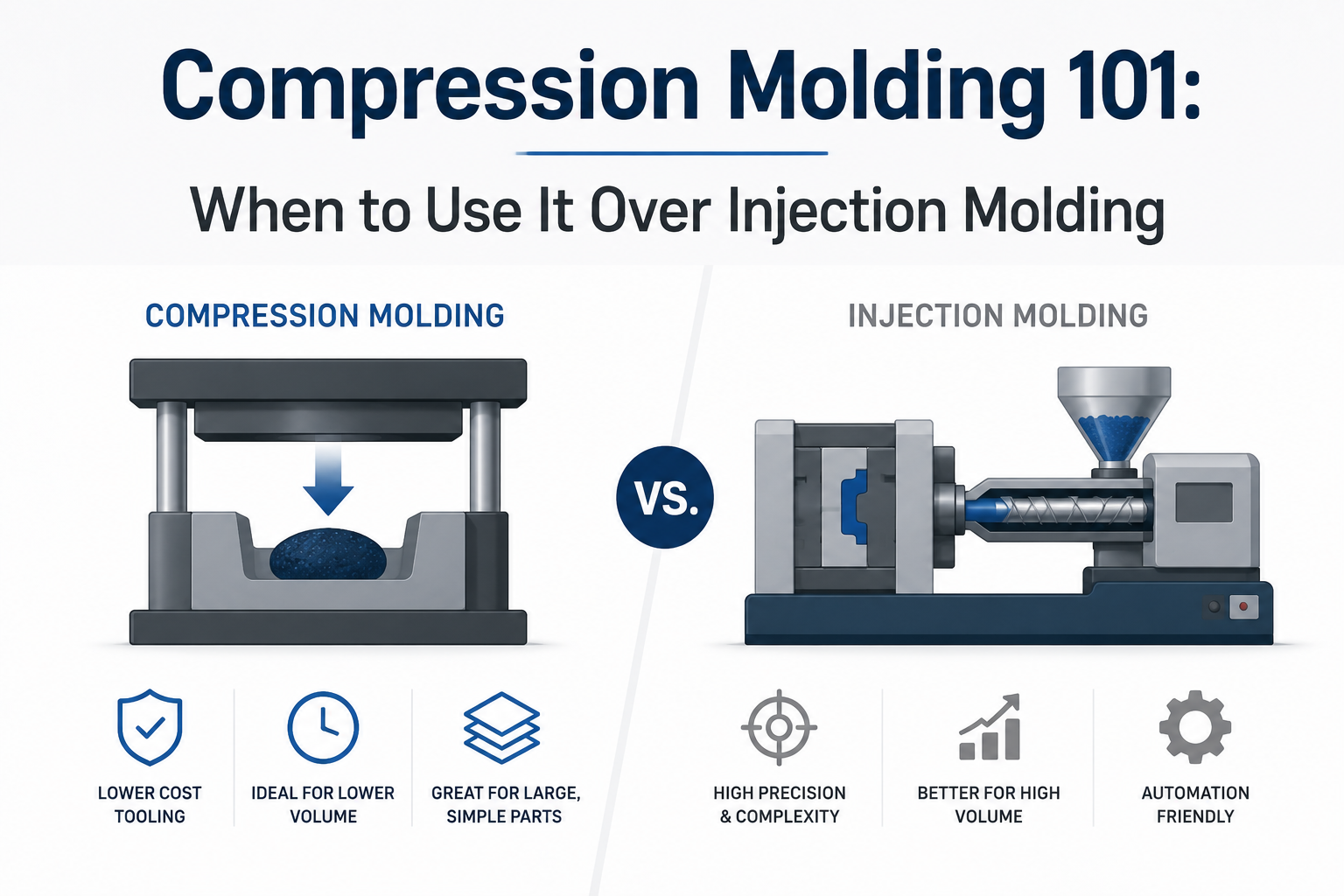
Injection molding is the default for most plastic parts. But for large components, low volumes, or thermoset materials, compression molding is often the better process, and the better cost. Here is how to know when it applies to your project.
How Compression Molding Works
Compression molding starts with a pre-measured material charge, a measured volume or weight of uncured material placed directly into an open, heated mold cavity. The mold closes under hydraulic pressure, and the combination of heat and pressure forces the material to flow and fill the cavity. For thermosets, the material cures (crosslinks) while in the mold. For rubber and some thermoplastics, it vulcanizes or solidifies.
There is no runner system, no gate, and no injection screw. The material goes straight into the cavity. This simplicity is both the strength and the limitation of the process.
Advantages: Where Compression Molding Wins
● Lower tooling cost: Without a runner system, gating, or injection unit, molds are mechanically simpler and less expensive to build. For large parts or low volumes, this matters.
● Minimal material waste: No sprue, no runner, no cold slug. Material waste is limited to flash, which is a thin film of material that squeezes out at the parting line and is trimmed off.
● Large part capability: Injection molding becomes expensive and mechanically complex for very large parts. Compression molding scales well for parts 2 feet across or larger.
● Thermoset compatibility: Materials like phenolic, melamine, urea-formaldehyde, and bulk molding compound (BMC) cannot be injection molded in the traditional sense. Compression molding is the standard process for these materials.
Disadvantages: Where It Falls Short
● Slower cycle time: Thermosets need time to cure under heat and pressure. Cycle times of 2 to 5 minutes are common, compared to 20 to 60 seconds for injection molding.
● Flash removal required: Almost every compression molded part has some flash at the parting line. Trimming adds a secondary labor step.
● Less dimensional consistency: Manual or semi-automated charge placement means part weight and thickness can vary more than injection molding.
Best Applications for Compression Molding
Compression molding is the right process for:
● Electrical insulators and switchgear components (phenolic and BMC)
● Pot handles, knobs, and appliance housings (urea or melamine)
● Automotive grommets, seals, and rubber components
● Large structural composite parts (SMC, glass-filled thermosets)
● Container lids and closures at low-to-mid volumes
Next Step: Not sure whether compression or injection molding is right for your part? Contact NICE Rapid at nicerapid.com for a process recommendation with no commitment required.

 Welcome to CreativeGeneralist.com, your premier destination for authentic news, captivating stories, and insightful posts curated from across the globe. We meticulously select diverse content to inform, entertain, and inspire.