Medically reviewed and authored by Larry M. Wolford, DMD — Board-Certified Oral & Maxillofacial Surgeon, Dallas, TX. Last reviewed: June 2026.
Some bite and jaw problems cannot be solved by braces alone. When the upper and lower jaws are positioned incorrectly relative to one another or to the rest of the face, the teeth may straighten with orthodontics but still not meet properly — and function and facial balance may remain off. Orthognathic surgery, often called corrective jaw surgery, repositions the jaws themselves to restore proper alignment, function, and appearance.
What Orthognathic Surgery Treats
Orthognathic surgery addresses skeletal discrepancies — differences in the size or position of the jawbones — rather than the position of individual teeth. Conditions commonly corrected include:
- Underbite, where the lower jaw projects ahead of the upper jaw
- Overbite or a recessed lower jaw, where the lower jaw sits too far back
- Open bite, where the front teeth do not touch even when the back teeth are closed
- Facial asymmetry, where one side of the jaw is longer or positioned differently than the other
- Difficulty chewing, biting, or speaking caused by jaw misalignment
- Airway and breathing problems, since jaw position strongly influences the space behind the tongue
These issues can be developmental, related to growth differences, or the result of trauma or joint disease.
How Orthodontics and Surgery Work Together
Most orthognathic cases are a partnership between an orthodontist and an oral and maxillofacial surgeon. Braces or aligners are typically used before surgery to position the teeth properly within each jaw, so that when the jaws are moved into their correct relationship, the teeth fit together accurately. Orthodontic treatment usually continues for a period after surgery to fine-tune the bite. This coordinated planning is what allows the final result to be both functional and stable.
The Procedures Involved
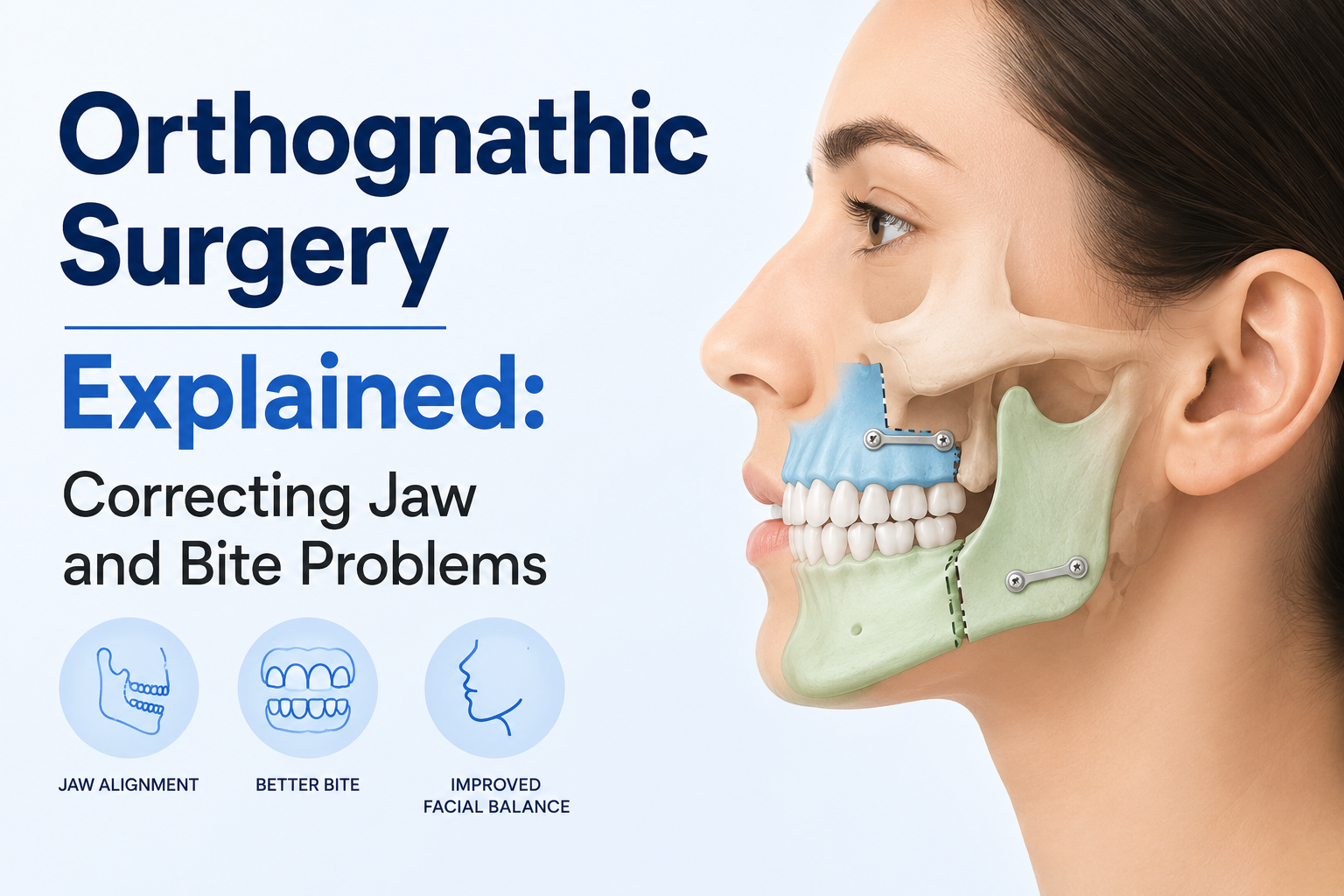
The specific operation depends on which jaw or jaws need to move. Surgery on the upper jaw (the Le Fort I osteotomy) allows the maxilla to be repositioned up, down, forward, or back. Surgery on the lower jaw (commonly a sagittal split osteotomy) repositions the mandible. The chin can be adjusted with a separate procedure (genioplasty) to improve balance and, in some cases, airway support. Many patients need a combination performed in a single operation. Today these procedures are planned with three-dimensional imaging and virtual surgical planning, which improves precision and predictability.
What Recovery Looks Like
Orthognathic surgery is performed under general anesthesia, often with a short hospital stay. The jaws are stabilized internally with small plates and screws, so most patients are not wired shut as they once were, though dietary restrictions still apply. Expect swelling that peaks in the first week and then steadily improves, a soft or liquid diet during early healing, and a gradual return to normal activity over several weeks. Numbness in the lips or chin is common early on as nerves recover, and most sensation returns over time. Full healing and final settling of the bite occur over several months.
Benefits Beyond Appearance
While orthognathic surgery can dramatically improve facial harmony, its benefits are deeply functional. Patients often gain the ability to chew comfortably and evenly, speak more clearly, and breathe better — particularly when jaw repositioning opens the airway. Correcting a bad bite can also reduce abnormal wear on the teeth and ease strain on the jaw joints and muscles.
Is It Right for You?
Orthognathic surgery is appropriate when a jaw discrepancy affects function, joint health, breathing, or facial balance in a way that orthodontics alone cannot resolve. A comprehensive evaluation — including imaging, dental models, and coordination with your orthodontist — determines whether surgery is indicated and exactly how the jaws should be repositioned.
To discuss corrective jaw surgery with Dr. Larry M. Wolford in Dallas, Texas, call (214) 828-9115.
Educational disclaimer: This article is for general informational purposes only and is not a substitute for professional medical advice, diagnosis, or treatment. Always consult a qualified healthcare provider regarding your specific condition.

 Welcome to CreativeGeneralist.com, your premier destination for authentic news, captivating stories, and insightful posts curated from across the globe. We meticulously select diverse content to inform, entertain, and inspire.