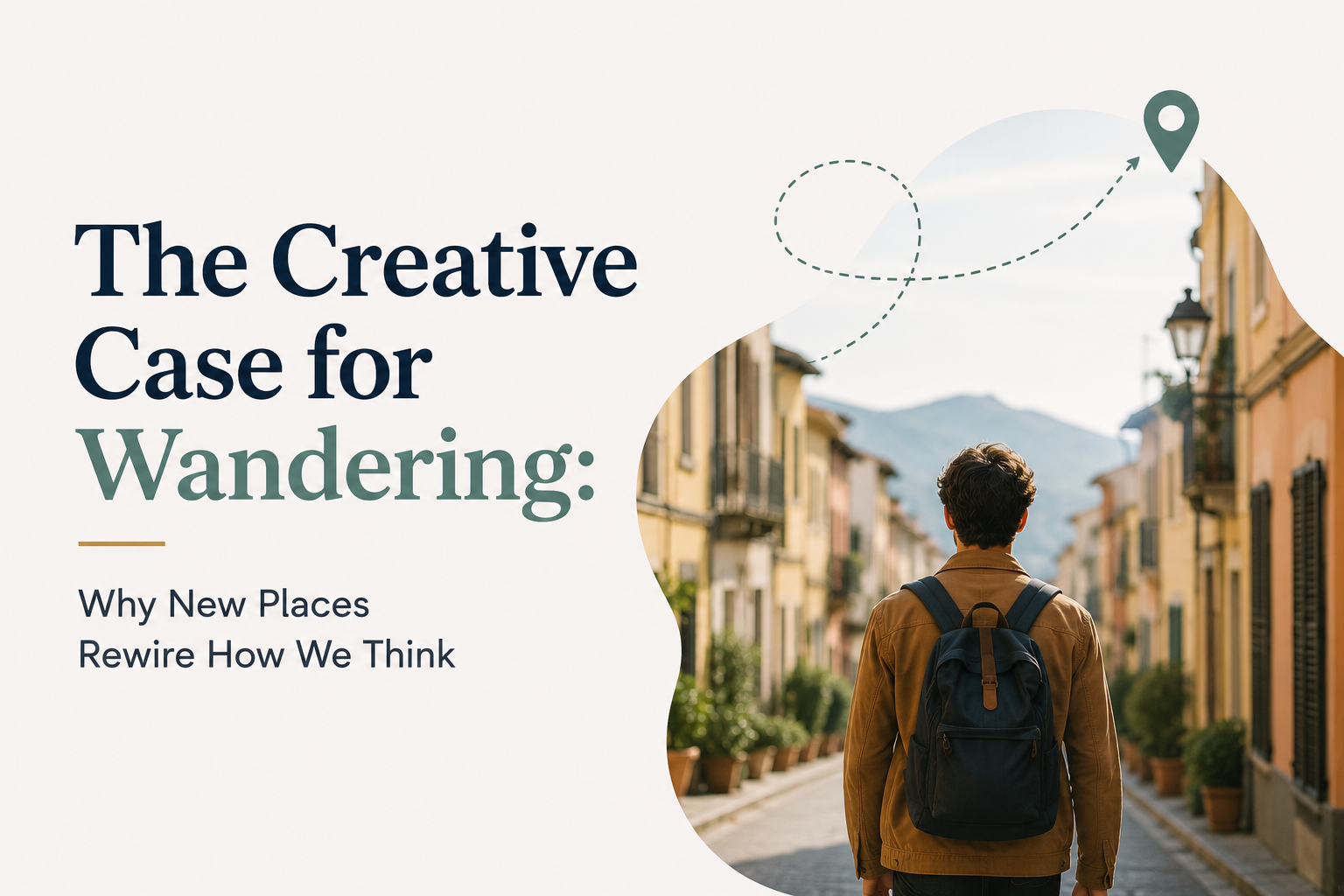
Creative people have always been drawn to travel, and not by accident. There is a genuine cognitive mechanism behind the cliché: exposure to unfamiliar environments loosens the grooves our thinking settles into, forcing the brain to make new associations it would never form in the comfort of routine. A generalist — someone whose whole method is connecting ideas across domains — has a particular reason to wander. New places are raw material for new connections.
Novelty is fuel for the associative mind
Research on creativity keeps circling the same finding: novel, diverse experiences feed the kind of flexible thinking that produces original ideas. A different city organizes space differently, solves everyday problems differently, arranges its markets and streets and meals according to a logic that is not yours. Simply moving through it is a low-grade, continuous prompt to notice, compare, and recombine. For anyone whose work depends on fresh connections, travel is less a break from the work than a strange and effective form of it.
Where the friction should — and shouldn’t — be
Here is the nuance the romantics miss: productive creative friction comes from the place, not from your logistics. Getting pleasantly lost in an unfamiliar quarter is fuel. Standing at an airport unable to get online, unable to find your accommodation, stressed and disoriented, is just noise — the bad kind of friction that crowds out the good. Consider wandering somewhere as layered as Egypt, where every street holds five thousand years of accumulated human ingenuity. Arriving with an eSIM voor Egypte already running means the logistics dissolve into the background — you can translate, navigate, and follow a spontaneous detour down an interesting alley — leaving your attention free for the thing you actually came for: to notice, absorb, and let the place work on your mind. Connectivity services like Cellesim’s exist precisely to remove the wrong kind of friction so the right kind can do its work.
Habits that protect the wandering mind
· Clear the logistics in advance — connectivity, maps, documents — so your attention stays free to notice.
· Leave room for the unplanned detour; the best associations come from the streets you didn’t intend to walk.
· Capture ideas as they strike, before the next impression crowds them out.
· Keep your home line and tools working, so the world back home doesn’t intrude at the wrong moment.
How to travel like a generalist
If travel is raw material for the associative mind, it follows that some ways of traveling feed that mind better than others. The generalist’s version is deliberately broad: rather than optimizing a trip around a single interest, you graze widely — a morning in a food market watching how a supply chain actually works, an afternoon in a design museum, an evening conversation with someone whose profession you know nothing about. The goal is not expertise in any of it. It is exposure to many different systems of doing and thinking, because the raw ingredients of an original idea are usually two familiar things from domains that never normally meet.
Capturing matters as much as gathering. Impressions are perishable; the strange detail that could later spark a connection fades within hours if you do not catch it. The practiced wanderer keeps a running, low-effort net for ideas — a note, a voice memo, a quick photo of the thing that struck them — not to perform productivity, but because the mind that travels well is greedy for material and forgetful under stimulation. The point is to get the fragment down and move on, trusting that its usefulness may only become clear months later, back at the desk, beside some unrelated problem.
All of which is only possible if the logistics stay out of the way. This is the quiet argument running under everything above: the friction worth seeking is the productive kind — the disorientation of an unfamiliar place — and the friction worth eliminating is the administrative kind that hijacks your attention and gives nothing back. Clearing away the petty logistics in advance, connectivity included, is not the opposite of adventurous travel. It is what protects the bandwidth adventurous travel actually runs on, keeping your attention free for the noticing that is the entire point.
There is a deeper reason novelty works on the mind the way it does, and it reframes travel as something closer to a cognitive practice than a break from one. The brain is relentlessly efficient; in familiar surroundings it stops truly seeing, running on cached assumptions because it can. Drop it somewhere genuinely unfamiliar and that efficiency breaks down in the most productive way — suddenly it has to look, to interpret, to build fresh models instead of reaching for old ones. That heightened attention is the same state artists and thinkers chase by other means, and travel delivers it almost automatically, provided you do not immediately paper over the disorientation with the comforts of home. The generalist’s advantage is a willingness to stay in that unsettled, hyper-attentive state a little longer than is comfortable, and to treat the confusion not as a problem to solve but as the condition under which the interesting connections form. Seen this way, the goal of a well-run trip is not to feel at home everywhere; it is to preserve, for as long as possible, the fertile strangeness of not being at home at all — while quietly making sure the logistics never drag you back into the dull, managerial part of your mind.
Go looking for the unfamiliar
The generalist’s edge is range — the ability to draw a line between two things nobody thought belonged together. That range is not built at a desk; it is gathered out in the world, one unfamiliar street and strange meal and overheard rhythm at a time. Travel is among the most reliable ways to refill the well, provided you clear away the petty friction that would otherwise steal your attention. Handle the boring logistics before you go, and then go looking for the unfamiliar on purpose. Your next good idea is more likely to be waiting in a city you have never seen than in the room where you have already had all your old ones.

 Welcome to CreativeGeneralist.com, your premier destination for authentic news, captivating stories, and insightful posts curated from across the globe. We meticulously select diverse content to inform, entertain, and inspire.