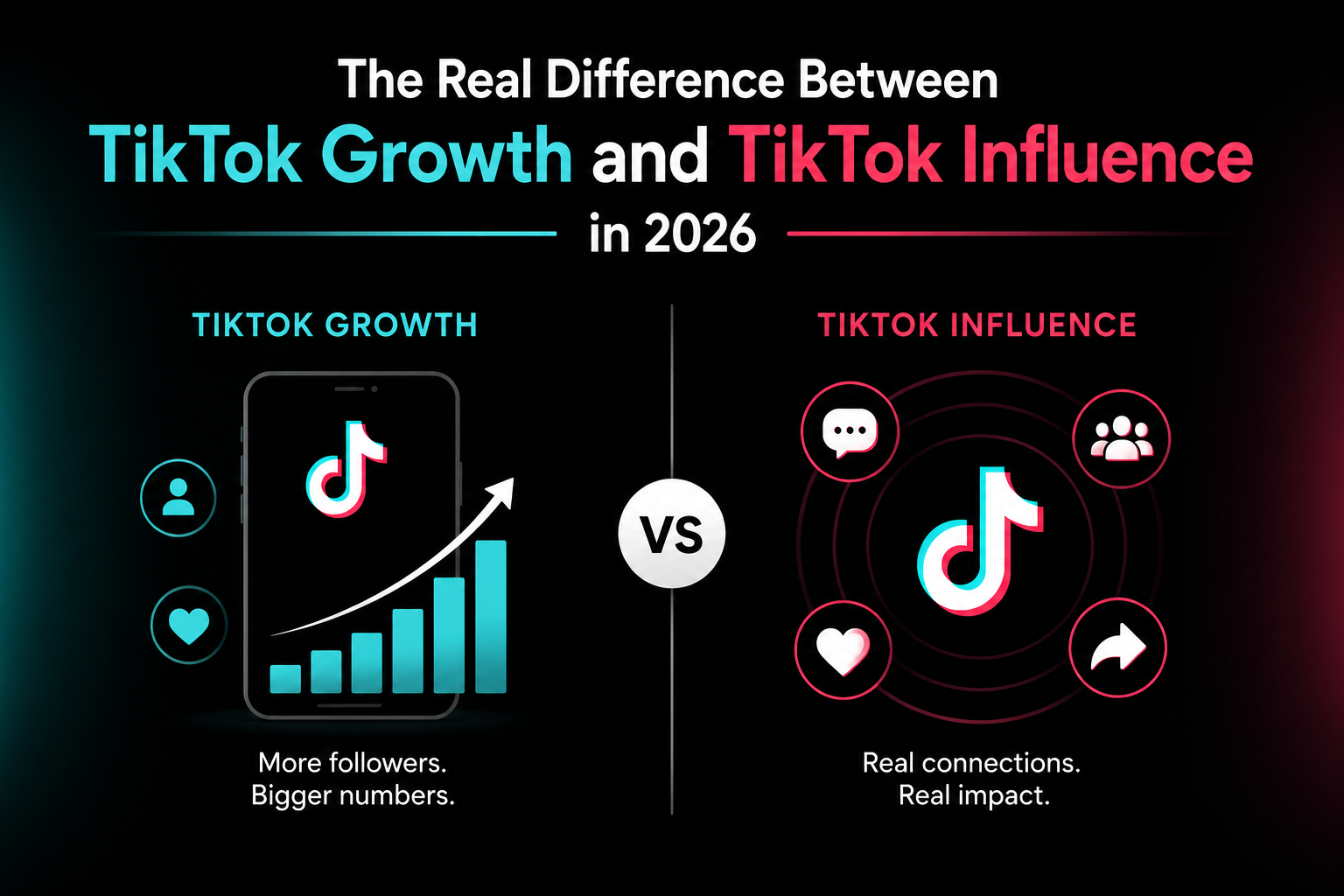
Why follower counts and view numbers tell an incomplete story – and what actually determines whether a TikTok presence produces real impact.
TikTok makes growth visible in ways that can be misleading. A follower count climbing toward six figures looks like success. A video reaching a million views looks like influence. Both numbers are real and both matter – but neither one automatically produces what creators and brands building on TikTok ultimately need: the capacity to change how people think, what they buy, or whether they come back.
Growth and influence are related but distinct. Understanding the difference between them – what produces each, how they interact, and why optimizing for growth without attending to influence produces hollow metrics that do not convert into lasting value – is one of the more practically important distinctions available to anyone building seriously on TikTok in 2026.
Creators comparing notes on what actually produces TikTok influence versus what produces view counts are doing it in communities like the buy TikTok likes thread in r/MrMarketing – worth reading alongside this breakdown for ground-level perspective.
Defining the Distinction Precisely
Growth on TikTok is a distribution metric. It measures how many accounts have been exposed to content – how many views accumulated, how many followers converted, how widely the For You Page pushed a video beyond its initial seed audience. Growth is determined primarily by TikTok’s distribution system – by the engagement signals content generates and the tier advancement process that either expands or limits how widely it travels.
Influence is a behavioral metric. It measures the degree to which exposure to content changes something about the viewer – their knowledge, their opinion, their intention, their action, or their ongoing relationship with the creator. A viewer who watched a video and formed a different opinion than they held before has been influenced. A viewer who watched, saved, researched the topic further, and made a purchase decision based on the creator’s recommendation has been influenced more deeply. A viewer who watched to completion, liked, and retained nothing has been reached but not influenced.
The distinction matters because the platform metrics that reflect growth – view count, completion rate, follower count – do not directly measure influence. A video can generate five million views and minimal influence. A video can generate fifty thousand views and substantial influence. The relationship between the two is not fixed – it varies based on content type, audience alignment, the depth of engagement the content creates, and whether the viewer encountered it in a state of active or passive consumption.
Why High View Counts Do Not Automatically Produce Influence
TikTok’s For You Page delivers content to users in a passive consumption context. The user is scrolling – not actively seeking information or deliberately choosing to engage with a specific creator’s perspective. Content appears, is evaluated in seconds, and is either engaged with or scrolled past. Even content that generates strong completion signals – viewers watching to the end – may not generate the kind of active cognitive engagement that produces lasting influence.
Passive completion is not the same as active processing. A viewer who watches a video to the end because the editing is entertaining or the format is satisfying has completed the video without necessarily engaging deeply with its content or perspective. TikTok’s algorithm rewards the completion signal – which reflects the content’s ability to hold attention – but the influence effect of attention-holding entertainment is typically lower than the influence effect of content that genuinely changes how the viewer thinks about something.
The passive consumption context also means that content encountering viewers who are not specifically receptive to its perspective generates reach without the audience openness that influence requires. A viewer whose behavioral history placed them in the seed audience for a specific piece of content may be loosely interested in the topic without being actively engaged with it at the moment of encounter. That loose interest produces view signals without the motivated attention that genuine influence requires.
What Actually Produces Influence on TikTok
Influence on TikTok is produced by a combination of content characteristics and audience conditions that are distinct from the characteristics that maximize reach – and understanding those specific drivers produces more deliberate influence-building than hoping reach will translate automatically.
Demonstrated expertise is the primary credibility foundation that makes influence possible. Content that reflects genuine knowledge – accurate information, specific detail, practical experience that general commentary cannot replicate – builds the credibility that allows a creator’s perspective to be accepted rather than evaluated skeptically. Viewers who find a creator genuinely credible are more likely to adopt the perspectives and information the content presents. Credibility is not claimed through assertions about expertise – it is demonstrated through the quality and accuracy of what the content actually contains.
Specificity of relevance is the primary driver of influence depth. Content that speaks precisely to a specific situation, question, or need that the viewer is currently experiencing generates influence because it encounters motivated attention rather than passive consumption. The viewer whose specific problem is being addressed watches with qualitatively different attention than the viewer who finds the topic generally interesting. That attention difference produces meaningfully different influence effects from equivalent view counts.
Emotional resonance produces influence through a mechanism distinct from information delivery but with comparable or stronger effects on behavior. Content that creates a genuine emotional response – recognition, inspiration, surprise, humor – produces stronger memory encoding than neutral information delivery. Emotionally resonant content is more likely to be recalled, shared, and acted on because the emotional component makes it more memorable than equivalent content delivered without emotional engagement.
Actionability converts influence potential into measurable influence outcomes. Content that gives viewers something specific they can do – a technique to apply, a decision to make, a resource to seek – produces behavioral change that is more trackable and more durable than attitude or opinion change alone. Actionable content generates save behavior – viewers preserving it for future reference – which is a strong proxy for the kind of influence that extends beyond the viewing moment.
The Follower Conversion Gap as an Influence Indicator
One of the most measurable manifestations of the growth-influence gap is follower conversion rate – the proportion of viewers who follow after watching. Follower conversion requires an active decision that passive positive response does not – the viewer must find the content compelling enough, and the creator credible and relevant enough, to commit to an ongoing relationship.
High-reach content with low influence produces low follower conversion rates because the reach is not accompanied by the engagement depth that motivates following. A video that reaches three million people through entertainment value or trend alignment – where the viewer’s relationship to the content is passive enjoyment rather than genuine creator interest – may generate a 0.05% follow rate. That is 1,500 followers from three million views – a number that looks small relative to the reach but accurately reflects the influence depth the content produced.
High-influence content with moderate reach produces higher follower conversion rates because viewers are more deeply engaged and more motivated to continue the relationship. A video that reaches 200,000 people through precise niche relevance and demonstrated expertise – where the viewer’s relationship to the content is active engagement rather than passive consumption – may generate a 1.5% to 2% follow rate. That is 3,000 to 4,000 followers from 200,000 views – more absolute follower acquisition than the high-reach low-influence video despite one-fifteenth the reach.
The follower quality difference between the two scenarios compounds over time. Followers acquired through genuine influence followed because the creator’s content genuinely addresses something they care about. They engage reliably with subsequent content, generate above-average engagement rates, and contribute to the algorithmic prior development that consistent high engagement builds. Followers acquired through entertainment reach engage inconsistently because their relationship to the content is interest rather than need.
How Brands Misread TikTok Influence
The growth-influence distinction is where many brand and marketing decisions on TikTok produce impressive view numbers and minimal commercial impact – because the standard creator evaluation framework measures growth without measuring influence.
Selecting creators based on follower count and average view metrics measures reach potential without measuring influence potential. A creator with two million followers and consistent ten million view videos has demonstrated the ability to generate distribution. Whether that distribution translates into purchase intent, brand consideration, or behavioral change for a specific product in a specific category is a separate question that view count data does not answer.
The creators whose TikTok reach most reliably translates into commercial influence are typically not the ones with the highest view counts. They are creators whose audience has a specific and genuine relationship with the content category relevant to the product – whose followers followed because of demonstrated expertise or genuine relevance rather than entertainment appeal. A creator with 80,000 followers in a specific niche whose audience trusts their recommendations produces more commercial influence per viewer than a creator with eight million followers in a broad category whose audience follows for entertainment value.
The metrics that more reliably indicate commercial influence potential are comment quality – whether followers ask specific questions indicating active consideration rather than leaving generic reactions – save rate on product-relevant content – indicating that viewers found the content worth referencing – and follower engagement consistency – whether the audience engages reliably across content types or only on specific high-performing posts.
Building for Influence Rather Than Growth
The content strategy that maximizes influence on TikTok looks different from the strategy that maximizes reach – and understanding the specific differences produces better long-term outcomes for creators whose goals extend beyond view count accumulation.
Content designed for influence prioritizes depth over breadth. It goes further into a specific topic than broad appeal content can because its target audience has the interest level to follow and benefit from that depth. It accepts that the majority of casual viewers who encounter it will not find it immediately compelling – because it is not designed for casual viewers. It is designed for the specific viewers who are deeply interested in the topic and who will respond to genuine depth with the kind of engaged behavior that produces lasting influence.
Content designed for influence builds credibility consistently across many pieces rather than optimizing for individual viral moments. Credibility accumulates through demonstrated expertise over time – a pattern that requires sustained output within a specific domain. The creator whose audience trusts their perspective has built that trust through consistent demonstration of knowledge and accuracy rather than through any single piece of content.
The measurement framework that reflects influence rather than growth tracks behavioral metrics – follow conversion rate, save rate, comment quality, and external action indicators – rather than reach metrics. View count and completion rate are necessary inputs to influence but insufficient measures of it. Building a measurement practice around behavioral outcomes rather than distribution metrics produces feedback about whether the content strategy is producing genuine influence or simply generating reach.
Why Influence Compounds and Growth Does Not
The most significant strategic difference between optimizing for growth and optimizing for influence is their respective compounding dynamics over time.
Growth does not compound in the same way influence does. Each piece of content generates its own distribution through the seed evaluation and tier advancement process – but that distribution does not automatically improve the conditions for the next piece of content’s reach. A viral video produces a temporary spike in account visibility that may bring in new followers, but if those followers were attracted by the specific viral content rather than by genuine ongoing interest, they do not contribute to the engagement foundation that improves future distribution conditions.
Influence compounds through audience relationship depth. Each piece of content that generates genuine influence – changing a viewer’s knowledge, opinion, or behavior – deepens the relationship between that viewer and the creator. Deepened relationships produce more reliable engagement on subsequent content. More reliable engagement produces stronger algorithmic signals. Stronger signals produce better distribution conditions for future content. Each cycle of genuine influence builds the audience quality that makes the next cycle more accessible.
The creators who build durable TikTok presences that convert into real commercial and community value are the ones who understood that influence – not reach – is the metric worth optimizing for. The reach follows when the influence is genuine. The influence does not follow automatically when the reach is high.
This guide reflects independent editorial research and judgment. No commercial relationships influenced the content.

 Welcome to CreativeGeneralist.com, your premier destination for authentic news, captivating stories, and insightful posts curated from across the globe. We meticulously select diverse content to inform, entertain, and inspire.