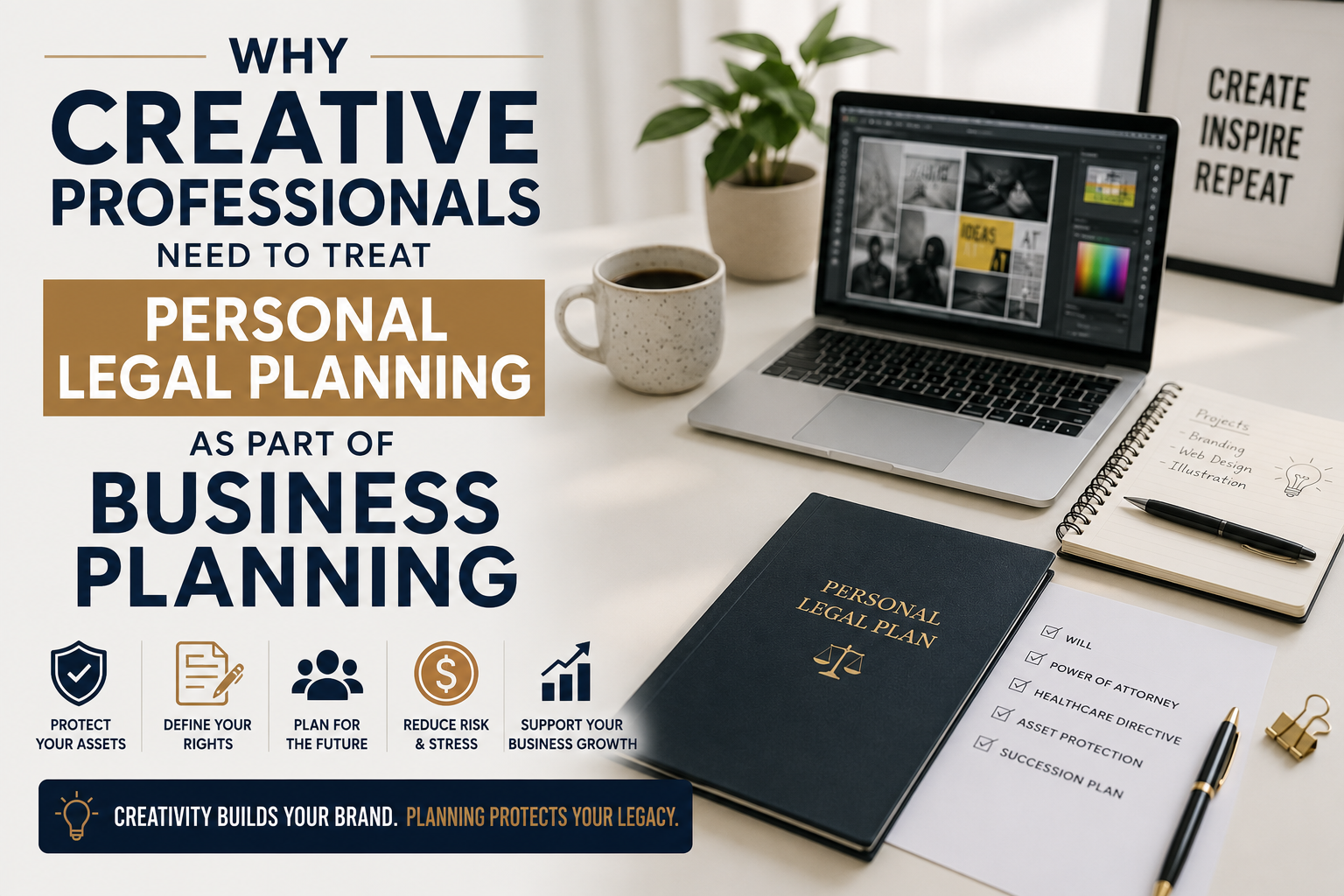
Creative professionals often build careers around flexibility. Designers, photographers, writers, filmmakers, consultants and digital creators may work across several projects, combine employment with freelance work or operate through a small business.
That independence can be rewarding, but it also means that personal and business affairs are often closely connected. A relationship breakdown can affect business assets and income. Illness or death can leave intellectual property, client accounts and unfinished projects without clear management. Poor record-keeping can make it difficult to establish ownership or value.
For that reason, personal legal planning should not be viewed as separate from business planning. The two frequently overlap.
Keep personal and business finances distinguishable
Many creative businesses begin informally. A person may receive project income into an existing account, buy equipment personally and use part of the family home as a studio or office.
As the business develops, those arrangements can become difficult to untangle. Personal savings may be used to fund the business, while business income may be applied to household expenses. Equipment, software licences and intellectual property may be acquired without clear documentation showing who owns them.
Separate accounts and reliable records make it easier to understand the financial position of the business. They may also become important if the owner later sells the business, admits a partner, seeks finance or becomes involved in a family-law property settlement.
Good records should identify:
- income earned by the business;
- expenses paid personally or through the business;
- significant equipment and other assets;
- outstanding client invoices;
- loans or contributions made by family members; and
- ownership of intellectual property and digital assets.
The purpose is not merely administrative neatness. Clear records can help establish what exists, how it was acquired and what it may be worth.
A relationship breakdown can affect creative businesses
People sometimes assume that a business registered in one person’s name is automatically excluded from a property settlement. That is not necessarily correct.
In Australian family law, the parties’ property interests are generally identified and valued before their contributions and future circumstances are considered. A creative business, company shareholding, partnership interest or valuable body of intellectual property may form part of the overall asset pool.
The business does not need to be a large agency or established company to have value. A sole practice may hold recurring client relationships, a recognised trading name, valuable equipment, digital content, licences or goodwill associated with the owner’s reputation.
Valuation can be particularly difficult when the business depends heavily on one person’s skills. Current income, historical earnings, future work, liabilities and the extent to which clients are attached personally to the owner may all be relevant.
The Holt & Macdonald guide to property division after separation explains that Australian family law does not impose an automatic 50/50 division. The process involves identifying the asset pool, assessing contributions, considering future needs and determining whether the outcome is just and equitable.
Creative professionals facing separation should avoid making substantial transfers, disposing of assets or changing business structures without advice. Decisions made in reaction to a relationship breakdown can create accounting, taxation and evidentiary complications.
Intellectual property should not be overlooked
Creative work can produce assets that are less visible than cash or equipment. Copyright, trademarks, domain names, digital products, licensing arrangements, mailing lists and monetised online accounts may all have commercial value.
Ownership should be considered at the beginning of a project rather than after a dispute develops.
Where several people collaborate, the parties should clarify:
- who owns the finished work;
- whether contributors assign or retain rights;
- how revenue will be divided;
- who may reuse the work;
- whether a client receives ownership or only a licence; and
- what happens when the collaboration ends.
Written agreements are especially important where work is created through a company, partnership or informal collective. Assumptions about ownership can differ sharply, even among people who initially had a cooperative relationship.
Estate planning protects more than physical property
A will is often associated with houses, savings and personal possessions. For a creative professional, the estate may also include copyrights, royalties, unpublished work, online businesses and rights under continuing contracts.
Without clear instructions, an executor may struggle to identify those assets or determine how they should be managed. Family members may not know which accounts generate income, where original files are stored or whether licensing agreements remain active.
A properly prepared will can appoint an executor and direct how estate assets should be distributed. Depending on the circumstances, it may also establish trusts, deal with business interests or provide for particular beneficiaries.
Holt & Macdonald’s guide on how to make a valid will in Victoria discusses testamentary capacity, signing requirements, executors, beneficiaries and the risks associated with informal or do-it-yourself wills.
Creative professionals should also prepare a secure inventory of important digital and commercial information. This might identify:
- domain names and website hosting arrangements;
- cloud-storage locations;
- business email accounts;
- subscription platforms;
- royalty and licensing accounts;
- social-media channels;
- digital wallets;
- client-management systems; and
- the location of contracts and financial records.
Passwords should be stored securely rather than written directly into a will, which may later become accessible through court records.
The executor may need to manage an active business
The death of a sole trader or small-business owner can leave projects unfinished and clients waiting for information. The executor may need to secure business records, collect outstanding invoices, preserve intellectual property and decide whether existing commitments can be completed.
The executor’s authority may also need to be formally recognised through a grant of probate.
Probate is the Supreme Court process by which a will is recognised and the executor is authorised to administer the estate. It is not required in every estate, but financial institutions and asset holders may require it before releasing or transferring substantial assets.
The Holt & Macdonald guide explaining when probate is required in Victoria outlines circumstances in which a grant may be needed and the general stages involved in the application process.
The choice of executor therefore deserves careful thought. A trusted relative may understand the family but have little knowledge of the business. In some circumstances, appointing more than one executor or ensuring that specialist advice is available may be appropriate.
Powers of attorney matter during a person’s lifetime
A will operates after death. It does not give another person authority to manage a business if the owner becomes unable to make decisions because of illness or injury.
Powers of attorney and related advance-planning documents can help address that risk. The appointed person may need to deal with accounts, contracts, property and business expenses while the owner is incapacitated.
The choice of attorney should take account of the person’s reliability, financial competence and ability to manage conflicts of interest. A family member who is caring and trustworthy may not necessarily be the most suitable person to administer a complex creative business.
It can also be useful to document practical continuity arrangements. Clients and collaborators may need to know who can access project files, communicate about deadlines or arrange the orderly transfer of work.
Legal planning supports creative independence
Legal planning is sometimes seen as restrictive or overly formal. In practice, clear arrangements can protect the flexibility that attracts people to creative work in the first place.
Separate financial records make business decisions easier to evaluate. Written agreements reduce uncertainty between collaborators. Estate-planning documents help preserve assets and provide authority when the owner cannot act personally.
The objective is not to anticipate every possible problem. It is to ensure that a business built on creativity is supported by structures capable of dealing with change.
For creative professionals, personal relationships, intellectual property and business income are often closely connected. Treating legal planning as part of ordinary business administration can protect both the work and the people who depend upon it.

 Welcome to CreativeGeneralist.com, your premier destination for authentic news, captivating stories, and insightful posts curated from across the globe. We meticulously select diverse content to inform, entertain, and inspire.