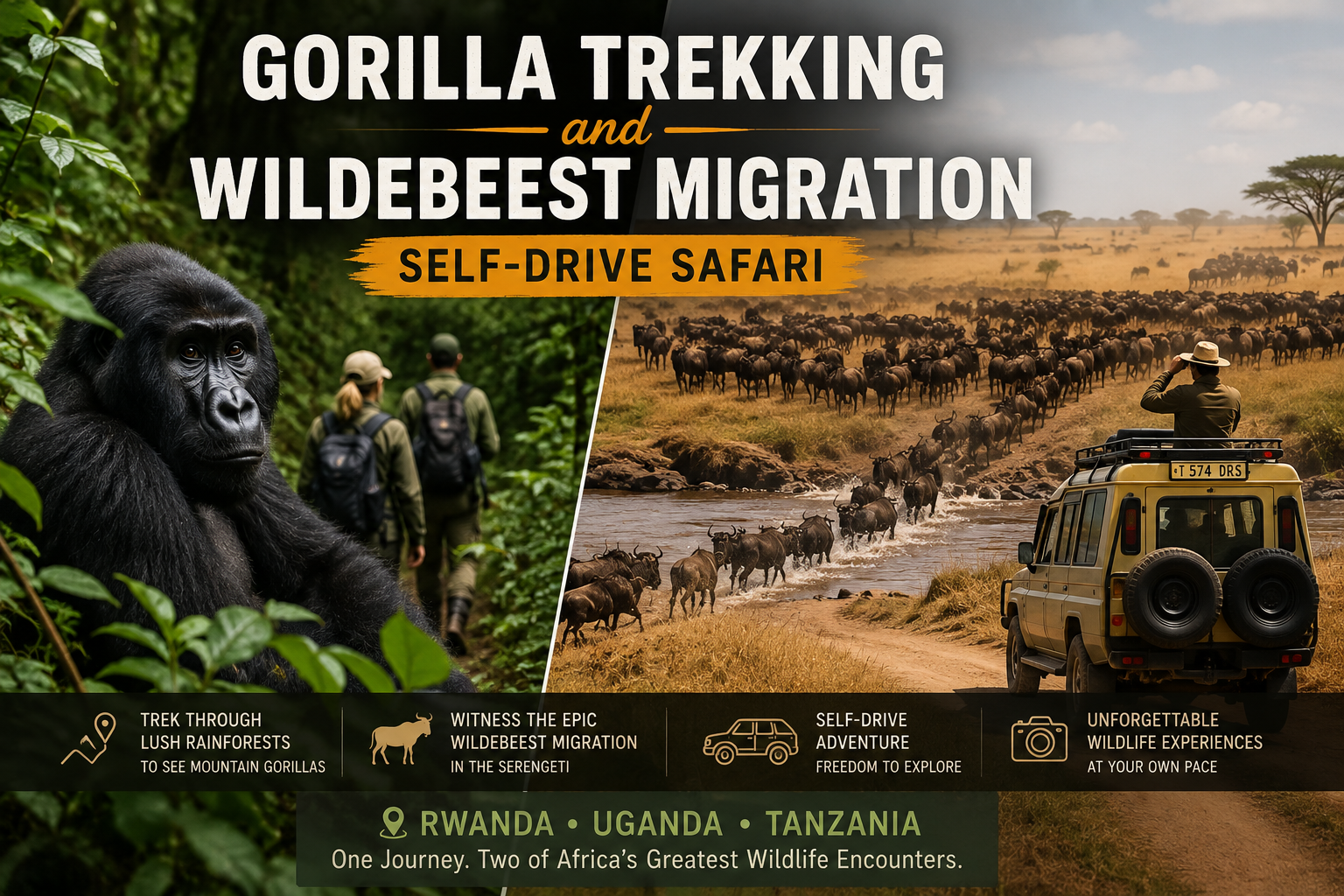
A Gorilla Trekking and Wildebeest Migration Self-Drive Safari is one of the most extraordinary road-trip adventures you can experience in East Africa. Imagine driving your own 4×4 through Uganda’s dramatic highlands, trekking through the ancient forests of Bwindi to encounter endangered mountain gorillas, then continuing across East Africa to the Masai Mara and Serengeti to witness thousands of wildebeest moving across the savannah.
This is not simply a safari. It is a multi-country expedition combining gorilla trekking, the Great Wildebeest Migration, African wildlife, scenic road trips, national parks and independent travel.
For adventurous travellers who want more freedom than a conventional guided safari, a self-drive trip through Uganda, Kenya and Tanzania can be an unforgettable way to explore East Africa.
However, this journey requires careful planning. Border crossings, vehicle documentation, gorilla trekking permits, national park fees, insurance, road conditions and wildlife-area driving rules all need to be considered before departure.
At Self drive Rwanda, we help travellers organize 4×4 self-drive adventures across East Africa, including vehicle rental, camping equipment, route planning and safari advice.
What Is a Gorilla Trekking and Wildebeest Migration Self-Drive Safari?
A Gorilla Trekking and Wildebeest Migration Self-Drive Safari combines two of East Africa’s greatest wildlife experiences:
- Mountain gorilla trekking in Uganda
- The Great Wildebeest Migration in Kenya and/or Tanzania
The trip can be customized according to your travel dates, available time and preferred migration experience.
A typical itinerary might begin in Entebbe or Kampala, Uganda, continue to Bwindi Impenetrable National Park for gorilla trekking, then travel through Uganda and Kenya to the Masai Mara National Reserve.
From Kenya, the adventure can continue south toward Tanzania, with time in Serengeti National Park, Ngorongoro Conservation Area and other northern Tanzania destinations.
Alternatively, travellers particularly interested in the calving season can concentrate more time around the southern Serengeti and Ndutu area.
The result is an incredible combination of rainforest and savannah, primates and predators, mountains and open plains.
Why Choose a Self-Drive Gorilla and Migration Safari?
A self-drive safari offers something that a traditional guided safari cannot always provide: freedom.
Instead of following a fixed schedule, you have more control over your daily route, stops and pace.
You can spend longer at a scenic viewpoint, stop for photography, enjoy a picnic, explore a local town or adjust your route according to road and wildlife conditions.
For experienced travellers, driving yourself through East Africa can also make the journey feel more like an expedition.
1. Freedom to Explore
Self-driving gives you greater flexibility throughout your journey.
You decide when to leave camp, where to stop and how long to spend in an area, subject to national park rules and operating hours.
2. A Real African Road-Trip Experience
The journey between destinations becomes part of the adventure.
Instead of simply flying between safari destinations, you experience changing landscapes, rural communities, mountains, forests, farms and wildlife areas along the way.
3. Excellent for Photographers
Wildlife photographers often appreciate the independence of self-drive travel.
You can organize your days around sunrise and sunset, spend longer observing wildlife and avoid rushing between sightings.
4. Combine Several Countries
A properly planned East African road trip can combine Uganda, Kenya and Tanzania in one adventure.
This makes it possible to experience mountain gorillas, the Masai Mara and Serengeti within the same journey.
5. Camping Makes the Adventure Even More Immersive
Travellers can choose from lodges, hotels, tented camps and campsites.
A 4×4 equipped with camping equipment can be an excellent option for travellers who want a more adventurous and flexible safari.
Mountain Gorilla Trekking in Uganda
One of the highlights of this journey is mountain gorilla trekking in southwestern Uganda.
Bwindi Impenetrable National Park is famous for its mountain gorillas and spectacular rainforest environment.
The trek begins early in the morning with a briefing before visitors enter the forest accompanied by trained trackers and guides.
The duration of the trek varies considerably. Gorillas are wild animals, and their location changes constantly, so the walking time can range from relatively short to several hours.
Once you find the gorilla family assigned to your group, you have the opportunity to observe these remarkable animals in their natural habitat according to the rules established by the park authorities.
The experience is completely different from a conventional game drive.
Instead of watching wildlife from a vehicle, you walk through the forest searching for gorillas.
You may encounter dense vegetation, steep slopes, muddy trails and changing weather conditions.
For this reason, reasonable fitness and suitable hiking clothing are important.
Gorilla Trekking Permits
Gorilla trekking requires a permit that must be arranged in advance.
Permit availability is limited, and demand can be particularly high during popular travel periods.
For travellers planning a self-drive safari, this is especially important because you may be responsible for your own transportation while the gorilla trek itself is conducted with the authorized trekking team.
We recommend securing the gorilla permit before finalizing the rest of your itinerary.
The Great Wildebeest Migration
After gorilla trekking, the adventure can continue toward Kenya and Tanzania to experience the Great Wildebeest Migration.
The migration involves enormous numbers of wildebeest moving through the Serengeti-Mara ecosystem in search of fresh grazing and water.
It is one of the world’s most famous wildlife spectacles.
However, the migration is not a single event that happens in one place on one specific date.
The herds move continuously throughout the year.
Their location is influenced by rainfall, grass availability and environmental conditions.
This means your itinerary should be designed around the seasonal movement of the herds, rather than simply choosing a destination called “the migration.”
Masai Mara: The Northern Migration Experience
The Masai Mara National Reserve in Kenya is one of the most famous places to experience migration.
During the appropriate season, enormous herds of wildebeest move into the Mara ecosystem.
The Mara River crossings are particularly famous, but crossings are unpredictable.
Wildebeest may gather near a crossing point for hours or days before crossing—or move away without crossing at all.
This is why responsible safari planning should never guarantee a river crossing.
Instead, travellers should allow several days in the region and work with current wildlife information.
For self-drivers, the Masai Mara provides an exciting wildlife experience, but visitors must follow park and reserve regulations and remain responsible around wildlife.
Serengeti: The Heart of the Migration
Across the border in Tanzania lies Serengeti National Park, one of Africa’s most important wildlife areas.
The Serengeti forms the southern and larger part of the Serengeti-Mara ecosystem.
The park offers exceptional opportunities to see wildebeest, zebra, gazelle, lions, cheetahs, leopards, elephants and many other species.
One of the greatest advantages of visiting Serengeti is that the park can offer outstanding wildlife viewing even when the migration herds are not concentrated in the area.
This makes Serengeti an essential destination for a broader East African safari.
When Is the Best Time for a Gorilla and Wildebeest Safari?
The best travel period depends on which part of the migration you want to experience.
January to March – Calving Season
The southern Serengeti and Ndutu region become especially important during the calving season.
Large numbers of wildebeest gather on the short-grass plains, and thousands of calves are born.
This period can also provide excellent predator activity because young animals attract lions, cheetahs, hyenas and other predators.
For travellers primarily interested in calving, a route focusing on Uganda + Serengeti/Ndutu + Ngorongoro can be particularly attractive.
April to May – Green Season
The landscape becomes greener and rainfall can influence road conditions.
Visitor numbers are often lower than during peak safari months.
This can be an excellent option for travellers who prefer fewer tourists and dramatic landscapes.
June to July – Northern Movement
As the dry season develops, the migration gradually moves northward.
This can be a good period for combining Serengeti with other northern Tanzania safari destinations.
August to October – Mara River Region
This is one of the most popular periods for travellers hoping to witness the migration around the Mara ecosystem.
The northern Serengeti and Masai Mara can offer spectacular wildlife experiences.
However, river crossings remain unpredictable.
November to December – Return South
With the arrival of short rains, the herds begin moving southward again.
The cycle continues.
Suggested 17-Day Self-Drive Itinerary
Below is an example itinerary for travellers who want to combine gorilla trekking with the Masai Mara and Serengeti.
Day 1 – Arrival in Uganda
Arrive in Entebbe and complete your vehicle handover.
Depending on your arrival time, spend the night in Entebbe or Kampala.
Receive a briefing covering the vehicle, route, border procedures and self-drive requirements.
Day 2 – Entebbe/Kampala to Western Uganda
Begin your road journey toward southwestern Uganda.
Enjoy the changing scenery as you leave the urban areas and travel toward the highlands.
Overnight en route.
Day 3 – Continue to Bwindi
Continue toward Bwindi Impenetrable National Park.
Depending on your selected gorilla sector, your accommodation can be arranged near the appropriate park entrance.
Day 4 – Gorilla Trekking
This is the major primate highlight of the trip.
After an early breakfast, proceed to the gorilla trekking briefing point.
Spend the day trekking through the forest and observing mountain gorillas.
Return to your accommodation after the trek.
Day 5 – Bwindi and Lake Bunyonyi
Enjoy a relaxed morning or explore the beautiful surroundings.
Lake Bunyonyi is a popular option for travellers looking for scenery and relaxation after the trek.
Day 6 – Uganda to Kenya
Begin the journey toward Kenya.
Border arrangements should be confirmed in advance, particularly regarding the rental vehicle and cross-border authorization.
Overnight according to your selected route.
Day 7 – Enter the Masai Mara Area
Continue toward the Masai Mara region.
After arrival, settle into your campsite or lodge and prepare for your first full wildlife day.
Days 8–9 – Masai Mara Safari
Spend two full days exploring the reserve.
Search for wildebeest, zebra, giraffes, elephants, lions, cheetahs, leopards and other wildlife.
If travelling during the migration season, monitor the location of the herds and plan your game drives accordingly.
Day 10 – Masai Mara to Nairobi
Leave the Mara and drive toward Nairobi.
Use the opportunity to rest, resupply and prepare for the Tanzania section of the journey.
Day 11 – Nairobi to Northern Tanzania
Continue toward the Tanzania border and proceed toward the Arusha area.
Depending on border and road arrangements, the itinerary may require adjustments.
Day 12 – Arusha to Serengeti
Begin the journey toward Serengeti.
The drive itself becomes part of the safari, with changing landscapes as you approach the ecosystem.
Days 13–15 – Serengeti National Park
Spend three days exploring Serengeti.
Your exact area should be selected according to the season and current location of the migration.
During the appropriate months, northern Serengeti can be ideal for following the herds toward the Mara River.
During calving season, the southern Serengeti/Ndutu area may be preferable.
Day 16 – Serengeti to Ngorongoro
Leave Serengeti and travel toward the Ngorongoro area.
Depending on your itinerary, you can visit the crater the following morning or arrange your game drive according to your park schedule.
Day 17 – Ngorongoro Crater and Departure
Enjoy a crater game drive before continuing toward Arusha or your departure point.
Your East African self-drive adventure comes to an end.
What Vehicle Do You Need?
A reliable 4×4 safari vehicle is essential for this type of journey.
A normal two-wheel-drive rental car is not suitable for many safari routes.
For a multi-country adventure, we recommend a properly equipped Toyota Land Cruiser or similar 4×4.
Important features include:
- Genuine 4×4 capability
- Good ground clearance
- Reliable suspension
- Two spare tyres where appropriate
- Strong recovery equipment
- Good-quality all-terrain tyres
- Long-range fuel capacity
- Comprehensive insurance
- Emergency communication arrangements
- Unlimited mileage where available
- 24/7 roadside support
For camping safaris, a rooftop tent can provide a comfortable and practical sleeping solution.
Camping packages can include:
- Rooftop tent
- Mattress
- Sleeping bags
- Bedding
- Camping chairs
- Camping table
- Cooking equipment
- Plates and utensils
- Gas cooker
- Fridge or cooler
- Water containers
- Basic camping equipment
The exact equipment supplied depends on the vehicle and rental package.
Can You Self-Drive to Gorilla Trekking Areas?
Yes, you can drive yourself to the general gorilla trekking destination, but the trekking activity itself is not a self-drive experience.
The gorilla trek is conducted under the supervision of authorized guides and trackers.
Your rental vehicle allows you to travel independently to and from the trekking area, while the actual forest trek follows the regulations of the national park.
This combination gives you independence on the road while maintaining the required conservation and safety procedures during the gorilla experience.
Crossing Borders Between Uganda, Kenya and Tanzania
Cross-border travel is one of the most important aspects of planning this safari.
Not every rental vehicle is automatically permitted to cross international borders.
Before booking, confirm:
- Vehicle cross-border authorization
- Insurance validity in each country
- Temporary importation requirements
- Driver’s license requirements
- Vehicle registration documents
- Required letters of authorization
- Border fees
- Visa requirements
- Third-party insurance requirements
- Rental-company restrictions
A vehicle rented in one country may not automatically be allowed into another country.
This is why travelers should discuss the complete route with the rental company before making a reservation.
Accommodation Options
The great advantage of this safari is the wide range of accommodation available.
Budget
Public campsites and simple camps can significantly reduce accommodation costs.
This option works particularly well for experienced campers.
Mid-Range
Permanent tented camps, safari camps and comfortable lodges provide a balance between comfort and cost.
Luxury
Luxury tented camps and safari lodges provide excellent service, private rooms, meals and additional amenities.
A mixed approach is often ideal.
For example, you might camp during the road-trip sections and choose a comfortable lodge before and after gorilla trekking.
Self-Drive Safety and Responsible Safari Practices
Self-driving in East Africa is an incredible experience, but it requires responsibility.
Always follow local traffic laws and national park regulations.
Inside wildlife areas:
- Maintain a safe distance from animals.
- Never chase wildlife.
- Do not leave the vehicle where it is prohibited.
- Avoid making unnecessary noise.
- Follow designated roads and tracks.
- Respect other safari vehicles.
- Do not feed wildlife.
- Follow speed restrictions.
- Carry sufficient water.
- Avoid driving after park closing times.
Wild animals are unpredictable.
A responsible self-driver understands that the goal is not simply to get as close as possible, but to enjoy wildlife without disturbing it.
How Much Does a Gorilla and Migration Self-Drive Safari Cost?
The total cost depends heavily on the itinerary, travel season, number of travellers, vehicle type and accommodation.
Major expenses can include:
- 4×4 vehicle rental
- Camping equipment
- Gorilla trekking permit
- National park entry fees
- Conservation fees
- Camping fees
- Accommodation
- Border fees
- Visas
- Fuel
- Food
- Vehicle insurance
- Guide or ranger-related costs where required
- Crater-related fees
- Road tolls and other local charges
The biggest cost difference is usually between budget camping and lodge-based travel.
A group of four travellers sharing one 4×4 and camping can often reduce the per-person vehicle cost considerably compared with two travellers using a private lodge-based safari.
For an exact quotation, provide your travel dates, number of travellers, countries, preferred vehicle and accommodation style.
Why Book Your East African Self-Drive With Pendo La Africa Safaris?
Planning a multi-country self-drive safari is very different from simply renting a car.
You need a vehicle suitable for safari roads, appropriate documentation, border authorization and practical knowledge of the destinations you intend to visit.
At Self drive Tanzania, we help travellers plan independent East African road trips with suitable 4×4 vehicles and practical safari advice.
We can assist with:
- 4×4 vehicle rental
- Rooftop tent camping
- Full camping equipment
- Safari route planning
- Uganda self-drive
- Kenya self-drive
- Tanzania self-drive
- Gorilla trekking planning
- National park planning
- Camping recommendations
- Border-crossing advice
- Vehicle documentation
- One-way rental arrangements where available
- Safari logistics
Our goal is to give you the freedom of self-drive travel while helping you avoid the common logistical problems that can make a complicated East African road trip difficult.
Gorilla Trekking + Wildebeest Migration: The Ultimate East African Adventure
Few safari experiences compare with standing in the rainforest and watching a mountain gorilla family moving quietly through the vegetation.
Even fewer journeys combine that experience with watching thousands of wildebeest crossing the open plains of the Serengeti-Mara ecosystem.
A Gorilla Trekking and Wildebeest Migration Self-Drive Safari brings these two experiences together in one extraordinary adventure.
From the forests of Uganda to the grasslands of Kenya and Tanzania, every section of the journey offers something different.
You can trek for gorillas in Bwindi, search for predators in the Masai Mara, follow wildebeest through the Serengeti and explore the Ngorongoro Crater—all while experiencing East Africa from behind the wheel of your own 4×4.
The key is planning.
Choose your travel season carefully, reserve your gorilla permit early, select a properly equipped 4×4, confirm cross-border permissions and build enough flexibility into your itinerary to account for road conditions and wildlife movements.
For experienced and adventurous travellers, this can become much more than a holiday.
It can become the ultimate East African self-drive safari adventure.
Plan Your Gorilla and Wildebeest Self-Drive Safari
Ready to combine gorilla trekking with the Great Wildebeest Migration?
Contact Pendo La Africa Safaris to plan your East African self-drive adventure.
Tell us:
Your travel dates + number of travellers + countries you want to visit + preferred vehicle + camping or lodge accommodation
and we can help you build a practical self-drive itinerary covering Uganda, Kenya and Tanzania.
Your adventure starts with the right 4×4 and the right route.

 Welcome to CreativeGeneralist.com, your premier destination for authentic news, captivating stories, and insightful posts curated from across the globe. We meticulously select diverse content to inform, entertain, and inspire.