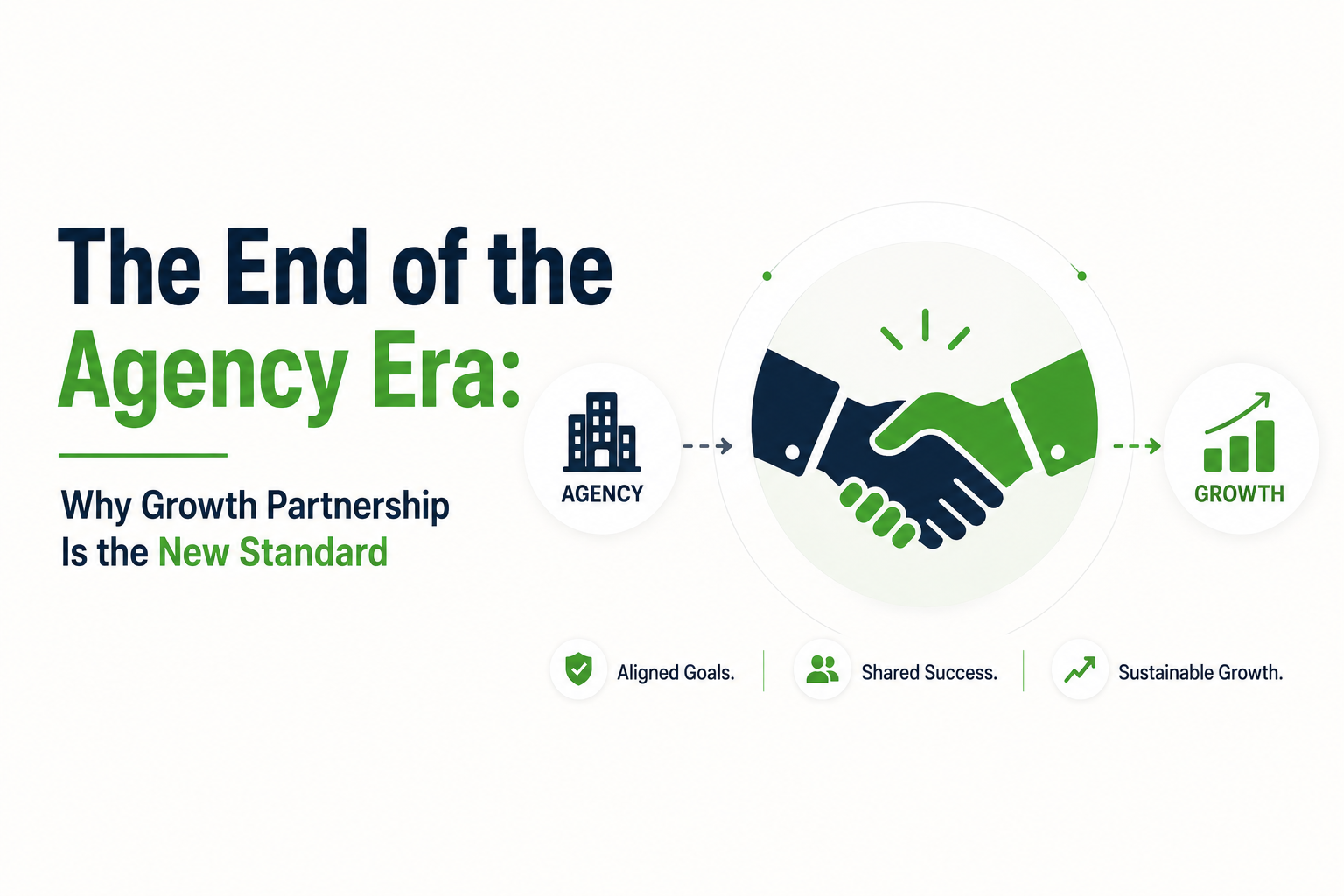
When a company says “we work with an agency,” it usually means one thing: content, ads, and creative are produced externally in exchange for a monthly fee. That model has worked for decades — but in 2026, it’s working for fewer and fewer companies, and the reason isn’t just that AI made production cheaper.
The agency model’s real breaking point
The core problem with the classic agency relationship isn’t speed or quality — it’s incentive misalignment. An agency on a fixed monthly retainer is rewarded for producing more work, not for producing more results. That’s not bad faith; it’s how the model is built: the invoice looks the same whether the agency succeeds or not.
Over time, this tends to produce the same pattern: the reports show activity — impressions, reach, number of assets delivered — while the company’s actual growth curve, in profitability, customer lifetime value, and operational efficiency, gets weaker. The agency “did its job,” but the job was never defined by the company’s growth.
How “growth partnership” builds a different structure
The growth engineering, or “growth partner,” model targets this incentive problem directly. The difference isn’t in who does the work — it’s in how success is defined. An agency says “we produced 10 pieces of content.” A growth partner aims to say “the company’s EBITDA grew by X, and much of that came from our intervention.”
In practice, this changes three things:
The measurement framework changes. What’s tracked is no longer impressions or reach, but actual financial impact. At Sellf, we call this RGI — Real Growth Index — a system that tracks, every quarter and every year, whether each dollar spent is converted into revenue or into real profit.
The starting point changes. A growth partner measures the brand’s current health before proposing a single campaign — which channel is working, which process is leaking, which spend is already wasted. Without that diagnosis, any strategy is a guess, not a diagnosis.
Accountability changes. The agency model says “we produce, you convert.” The growth partnership model requires the partner to actually be affected by the outcome — reputationally, and often structurally.
What the diagnosis actually looks like
A framework like BHS doesn’t produce a single “marketing health” score — it measures six dimensions independently:
- Operations: Are processes documented, repeatable, or dependent on one person?
- Marketing: Is the channel mix right, is targeting accurate, does content match the channel?
- Sales: Where exactly is the lead-to-close pipeline leaking?
- Finance: What does the cash cycle and margin structure actually look like?
- Product: Is the value proposition clear, is product-market fit still current?
- Brand perception: How does the target audience actually position the brand against competitors?
If any one of these six is weak, investment in the other five can’t fully compensate — a chain is only as strong as its weakest link. An agency usually focuses only on the marketing dimension because that’s what its contract defines; a growth partnership evaluates all six together, and is connected.
How different the contract structure can be
This difference in philosophy shows up at the contract table too. A classic agency contract typically defines three variables: scope (which services), duration (monthly/yearly), fee (fixed rate). Growth partnership contracts add a fourth layer: the definition of success — which financial metric, over what timeframe, measured how, is agreed upfront.
That doesn’t make the contract more complicated — it makes it simpler. It removes the six-months-later argument of “we did our job but the results didn’t come, and you never gave us a clear brief.” Both sides agree, from day one, on the same number.
Why this is accelerating now
Three things are driving this shift. First, AI has made content and ad production cheap enough that “output volume” is no longer a differentiator — everyone can produce more, so the real value has moved from production to precision. Second, a tighter economic environment (higher rates, shrinking margins) is forcing companies to move from “spend volume” to “spend efficiency.” Third, and least discussed: a generation of founders and CFOs has now seen the gap between activity and results not in a report, but on their own balance sheet — and that experience permanently changes what they ask in the next budget cycle.
It isn’t all-or-nothing
Reading this and concluding “we should cut every agency relationship” would also be wrong. In practice, most mature companies build a hybrid: for well-defined, limited-scope work — brand identity, creative production, a one-time launch — the agency model is still efficient, because success there is already clear and short-term. But for continuous, multi-channel growth responsibility, where results are only visible on the balance sheet months later, the agency model’s incentive structure falls short.
Making that distinction correctly is arguably a more important skill than the model itself: knowing which work is “production” and which requires “outcome accountability.” That’s exactly where most companies get it wrong.
Why the transition isn’t easy
This is easier to say than to do. Most companies moving toward a growth partnership model hit the same friction: the existing agency relationship is comfortable, familiar, and gives a sense of “at least we know what we’re getting.” Changing the measurement framework — looking at EBITDA instead of impressions — means more scrutiny and less comfort in the short term, because now every dollar of spend gets questioned.
That’s why the transition is usually gradual: first a diagnosis (something like BHS), then a small pilot area, then full-scope partnership. Switching all at once rarely works — because internal habits and reporting culture need to change too, not just the outside vendor.
What this means for a company
If a company is still measuring its agency’s performance by “how much content did they produce,” it’s probably asking the wrong question. The right question is: is every externally purchased service measurably increasing the company’s real profitability, or is it just producing activity?
The honest answer is often uncomfortable — because it can reveal that a line item paid for months, sometimes years, never had a measurable return. But that’s exactly why the question needs to be asked.
Sellf’s take on this shift is laid out in more detail in The End of the Agency Model.
FAQ
Is a growth partnership model more expensive than an agency? Not necessarily — the difference isn’t in cost, it’s in what’s measured. A growth partner typically recommends fewer, more precise interventions, because it measures where the system is leaking first.
Is the agency model “bad” for every company? No. For brand-building, long-term, or one-off projects, the agency model can still make sense. The problem is loading ongoing operational growth responsibility onto a model built for production, not outcomes.
How is RGI different from other growth metrics? Metrics like ROAS or reach measure channel-level impact; RGI tracks how much of the capital spent contributes to the company’s overall profitability (EBITDA), on a quarterly and annual basis — a company-level measurement, not a channel-level one.

 Welcome to CreativeGeneralist.com, your premier destination for authentic news, captivating stories, and insightful posts curated from across the globe. We meticulously select diverse content to inform, entertain, and inspire.