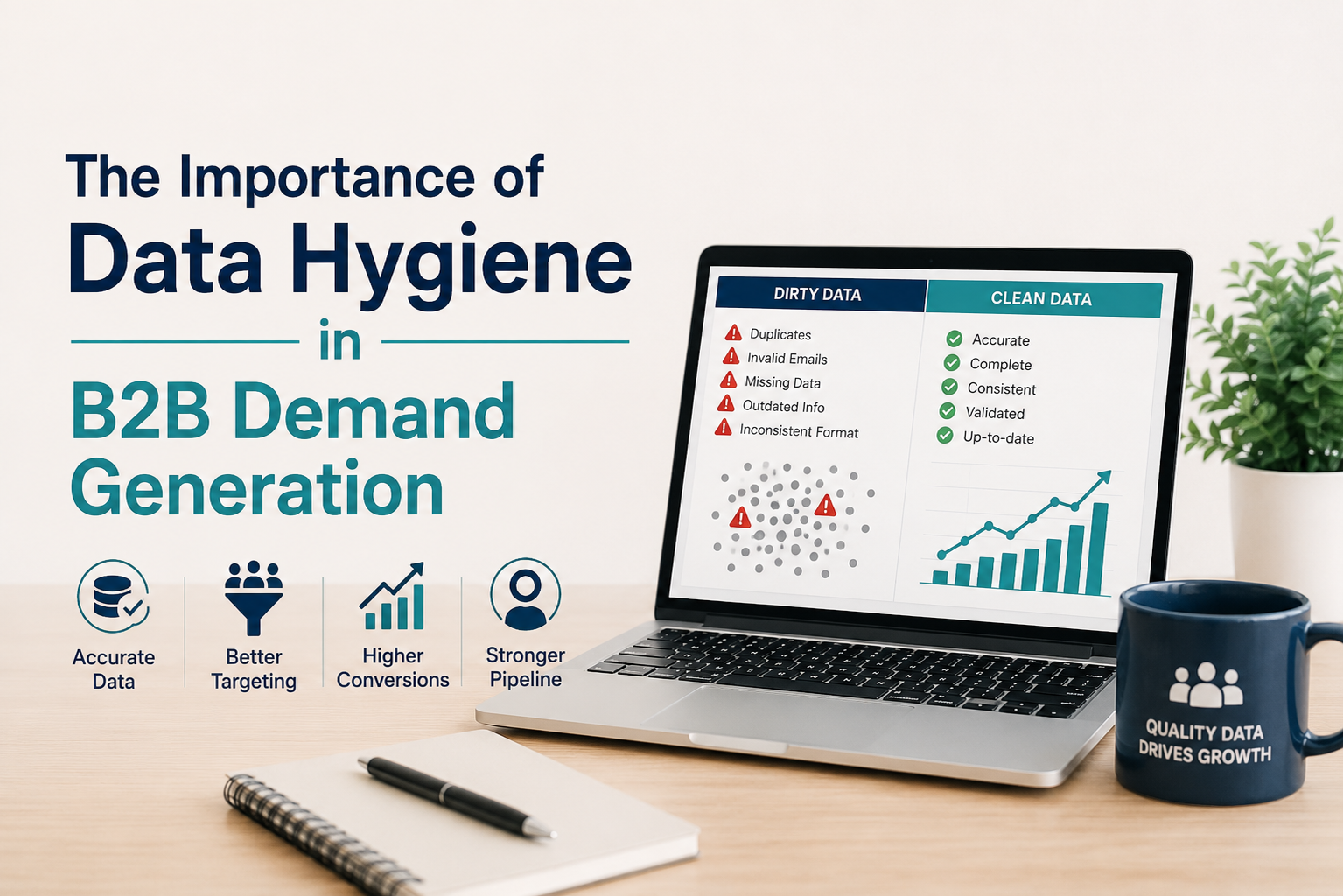
In the era of AI-driven marketing, predictive analytics, and personalized customer experiences, data has become one of the most valuable assets for every B2B organization. Every campaign, sales conversation, and marketing decision relies on the quality of the information stored within CRM systems, marketing automation platforms, and customer databases. Yet despite significant investments in technology and digital transformation, many organizations continue to struggle with an overlooked challenge—poor data hygiene.
Duplicate records, outdated contact information, invalid email addresses, incomplete company profiles, and inconsistent formatting can quietly undermine even the most sophisticated demand generation strategies. While these issues may seem minor individually, together they reduce campaign effectiveness, lower marketing efficiency, and create unnecessary friction between sales and marketing teams.
As B2B buying journeys become increasingly complex, maintaining clean, accurate, and continuously updated data is no longer a back-office task. It has become a strategic advantage that directly impacts lead quality, campaign performance, customer engagement, and revenue growth.
Data Quality Is the Foundation of Successful Demand Generation
Every demand generation strategy begins with understanding the audience.
Whether organizations are launching content syndication campaigns, running webinars, executing account-based marketing initiatives, or nurturing prospects through automated workflows, success depends on reaching the right people with the right message at the right time.
Accurate data enables marketers to identify ideal customer profiles, understand buying behavior, personalize communications, and prioritize high-value opportunities. Conversely, inaccurate or incomplete records lead to wasted advertising spend, poor customer experiences, and lower conversion rates.
No matter how advanced a marketing strategy may be, its success will always depend on the quality of the underlying data.
Why Poor Data Hygiene Costs More Than Organizations Realize
Many businesses underestimate the financial impact of poor-quality data.
Outdated contact information results in bounced emails, disconnected phone numbers, inaccurate reporting, and missed sales opportunities. Duplicate records create confusion for sales teams, while incomplete firmographic data limits segmentation and personalization efforts.
Recent industry studies continue to estimate that organizations lose significant revenue each year due to poor data quality, highlighting how inaccurate information affects productivity, operational efficiency, and customer engagement.
Instead of accelerating growth, poor data creates unnecessary obstacles throughout the revenue cycle.
Better Data Creates Better Customer Experiences
Modern B2B buyers expect personalized and relevant interactions.
Receiving duplicate emails, outdated offers, or irrelevant content quickly damages customer confidence.
Clean data allows marketing teams to understand customer preferences, business priorities, engagement history, and buying stages more accurately.
This enables organizations to deliver communications that feel timely, valuable, and personalized rather than generic or repetitive.
Strong customer experiences begin with reliable customer information.
Data Hygiene Improves B2B Email Deliverability
Email continues to be one of the most effective channels for B2B demand generation, but its success depends heavily on data quality.
Invalid email addresses, inactive contacts, duplicate subscribers, and outdated databases contribute to higher bounce rates, spam complaints, and declining sender reputation.
Maintaining clean contact databases significantly improves B2B Email Deliverability, ensuring marketing messages reach decision-makers instead of being filtered into spam folders or rejected by receiving mail servers.
Combined with authentication standards such as SPF, DKIM, and DMARC, effective data hygiene strengthens inbox placement while protecting brand reputation.
The result is greater engagement, healthier email performance, and stronger marketing outcomes.
Personalization Depends on Accurate Information
Artificial intelligence has dramatically expanded personalization capabilities.
Today’s marketing platforms can recommend content, predict buying behavior, optimize campaign timing, and deliver tailored experiences across multiple channels.
However, AI can only generate meaningful insights when supported by accurate data.
If customer records contain outdated information or missing attributes, personalization becomes inconsistent and less effective.
Organizations that maintain clean, enriched, and validated data enable AI to generate smarter recommendations while improving every customer interaction.
Stronger Segmentation Drives Better Results
Demand generation is becoming increasingly targeted.
Instead of broadcasting identical messages to broad audiences, marketers now create campaigns tailored to specific industries, company sizes, technologies, job functions, and purchasing stages.
Effective segmentation requires complete and reliable customer data.
When records are accurate and continuously updated, organizations can build highly relevant audience segments that improve engagement and increase conversion rates.
Better segmentation naturally produces better marketing performance.
Data Hygiene Strengthens Multi-Touch ABM Sequences
Account-Based Marketing has evolved beyond one-time outreach into coordinated, multi-channel engagement strategies.
Successful Multi-Touch ABM Sequences rely on accurate contact information, verified organizational hierarchies, complete buying committee data, and detailed engagement histories.
Clean data enables marketing and sales teams to coordinate personalized email campaigns, digital advertising, executive outreach, webinars, direct mail, and sales follow-ups without unnecessary duplication or inconsistent messaging.
When every interaction is supported by reliable information, account-based strategies become more relevant, more efficient, and more successful.
One of the most common challenges within B2B organizations is inconsistent information across departments.
Marketing may generate leads that sales cannot reach because contact information is outdated.
Sales representatives may update CRM records while marketing automation platforms continue using older versions.
Strong data governance creates a single, reliable source of customer information shared across sales, marketing, customer success, and operations.
This alignment improves collaboration while reducing manual effort and operational inefficiencies.
AI Makes Data Hygiene More Scalable
Managing thousands—or even millions—of customer records manually is no longer practical.
Artificial intelligence is increasingly helping organizations automate data validation, identify duplicate records, verify contact information, standardize formatting, enrich company profiles, and detect anomalies.
Machine learning continuously monitors databases to identify quality issues before they affect campaign performance.
Instead of performing periodic database cleanups, organizations can maintain continuously improving data quality through intelligent automation.
First-Party Data Is Becoming More Valuable
With increasing privacy regulations and the continued decline of third-party cookies, first-party data has become the foundation of modern demand generation.
Organizations that collect information directly through customer interactions build stronger relationships while maintaining greater control over data quality.
However, first-party data delivers maximum value only when it is properly maintained.
Regular validation, enrichment, consent management, and governance ensure customer information remains accurate and compliant over time.
Protecting and maintaining first-party data is now a strategic business priority.
Building a Sustainable Data Hygiene Strategy
Effective data hygiene is not achieved through occasional cleanup projects.
It requires continuous governance supported by technology, defined processes, and organizational accountability.
Successful organizations establish clear standards for data collection, validation, enrichment, deduplication, and ongoing maintenance. They regularly audit databases, automate quality checks, and ensure every customer interaction contributes to stronger, more accurate information.
When data quality becomes part of everyday operations, marketing performance improves consistently.
Measuring the Business Impact of Data Hygiene
Organizations increasingly evaluate data quality through measurable business outcomes rather than database size alone.
Important indicators include:
- Higher lead-to-opportunity conversion rates
- Improved email engagement and inbox placement
- Reduced bounce rates
- More accurate audience segmentation
- Better campaign ROI
- Faster sales follow-up
- Increased CRM accuracy
- Stronger customer retention
- Improved marketing and sales alignment
These outcomes demonstrate that clean data contributes directly to revenue generation—not simply operational efficiency.
Turning Better Data into Better Business Results
The future of B2B demand generation will be driven by organizations that treat data as a strategic business asset rather than a marketing byproduct. As AI, automation, predictive analytics, and personalization continue to evolve, clean and reliable data will remain the foundation that enables every successful campaign, customer interaction, and revenue opportunity.
Data hygiene is far more than maintaining an organized database. It empowers organizations to improve B2B Email Deliverability, execute more effective Multi-Touch ABM Sequences, strengthen customer relationships, and make smarter business decisions based on trustworthy insights.
If your organization is looking to improve demand generation through high-quality data, intelligent audience targeting, and performance-driven marketing strategies, reach out to Acceligize. With extensive expertise in B2B demand generation, verified data solutions, and account-based marketing, Acceligize helps businesses build cleaner databases, engage qualified decision-makers, and transform accurate data into measurable business growth.

 Welcome to CreativeGeneralist.com, your premier destination for authentic news, captivating stories, and insightful posts curated from across the globe. We meticulously select diverse content to inform, entertain, and inspire.