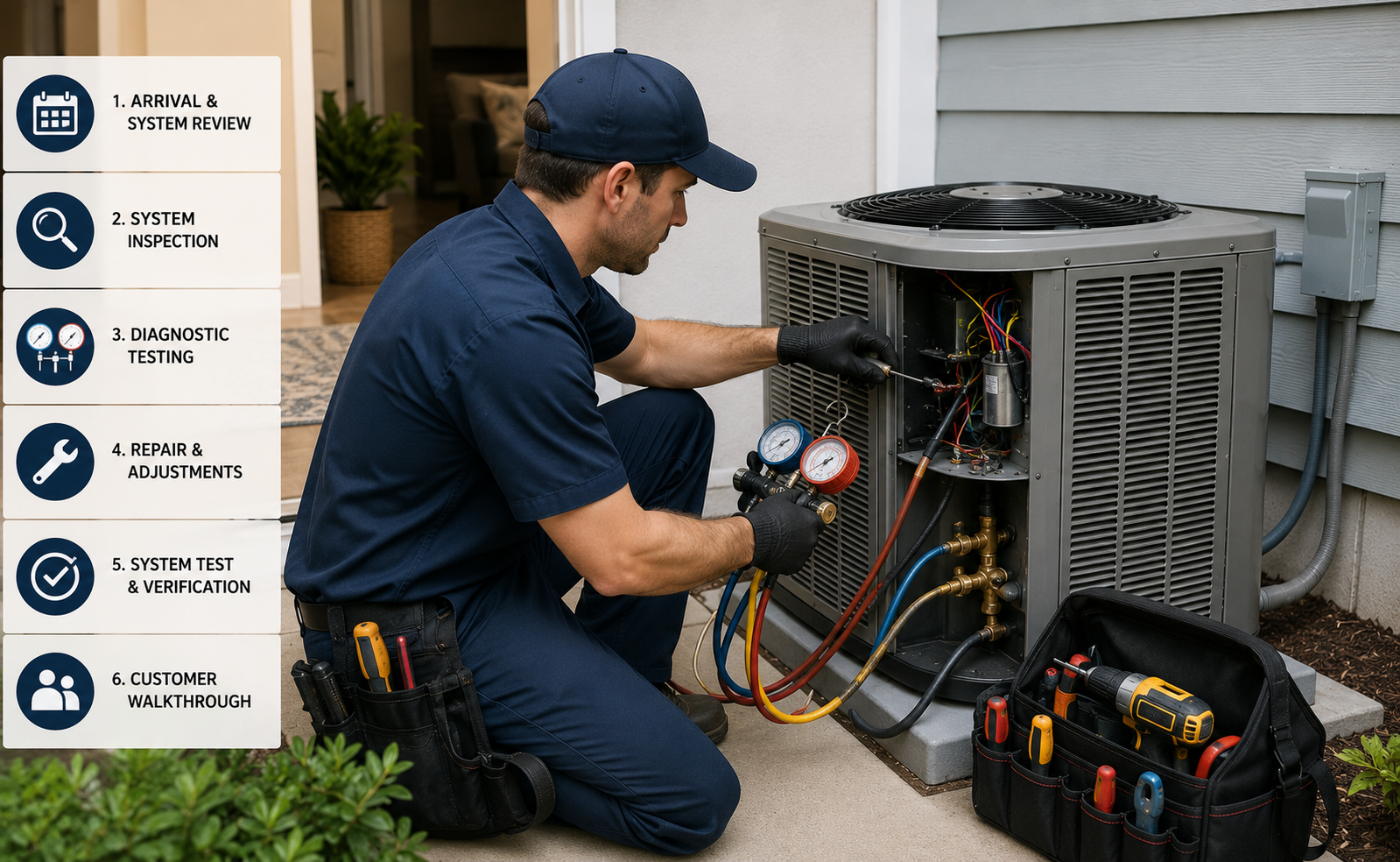
When an air conditioner suddenly stops cooling, homeowners often want one answer as quickly as possible: what went wrong? The reality is that several different components can create similar symptoms. Warm air from the vents, weak airflow, unusual noises, short cycling, or a system that refuses to start can each have multiple possible causes.
That is why professional air conditioning repair typically begins with diagnosis rather than immediately replacing parts. Understanding what happens during a service visit can help homeowners know what to expect and communicate more effectively with the technician.
The Visit Usually Starts With Questions
Before inspecting the equipment, an HVAC technician may ask the homeowner what has been happening.
Useful information can include when the problem started, whether it appeared suddenly or gradually, what sounds or odors have been noticed, and whether the system is cooling at all.
Homeowners may also be asked whether:
- The thermostat appears to be operating normally
- Air is coming from the vents
- Certain rooms are warmer than others
- The system turns on and off frequently
- Water has appeared near the indoor unit
- A circuit breaker has recently tripped
- The AC has required previous repairs
These details can help narrow the list of potential causes before more detailed testing begins.
Thermostat Operation Is Often Checked First
A malfunctioning cooling system does not always mean there is a major mechanical failure.
The thermostat is one of the first places worth checking because it controls when the cooling system operates. Incorrect settings, power problems, damaged wiring, or thermostat malfunctions can sometimes create symptoms that resemble equipment failure.
A technician may confirm that the thermostat is communicating properly with the HVAC system before moving on to other components.
This relatively simple step helps avoid making unnecessary assumptions about the cause of the problem.
Airflow Provides Important Clues
Airflow can reveal a great deal about how an air conditioning system is performing.
If very little air is coming from the vents, the technician may investigate potential restrictions or mechanical problems. Filters, blower components, ductwork, coils, and other parts of the system can all influence airflow.
Weak airflow may also make the home feel warmer even when the AC itself is producing cool air.
Because of this, professional diagnosis usually considers how air moves through the complete system rather than looking only at the outdoor equipment.
Electrical Components May Need Testing
Modern air conditioning systems depend on multiple electrical components to start, operate, and communicate correctly.
Capacitors, contactors, motors, wiring, breakers, safety switches, and control boards can all affect system operation.
A failed electrical component might prevent the outdoor unit from starting, cause a motor to operate incorrectly, or result in intermittent performance.
Testing helps technicians determine whether electricity is reaching the necessary components and whether those components are functioning within expected ranges.
Homeowners should generally avoid opening electrical compartments themselves. HVAC equipment can contain high-voltage components even when the system appears to be off.
Refrigerant Problems Require Proper Diagnosis
Homeowners sometimes assume an air conditioner that is not cooling simply “needs more refrigerant.”
The situation is usually more complicated.
Air conditioning systems are designed to operate with a specific refrigerant charge. If refrigerant levels are incorrect, technicians may need to determine why rather than simply adding more.
Leaks can develop in coils, connections, or refrigerant lines. Other system problems can also produce symptoms that resemble a refrigerant issue.
Proper testing is therefore important before deciding on the appropriate repair.
Frozen Coils Can Be a Symptom, Not the Root Cause
Ice on an air conditioning system may look like the obvious problem, but freezing is often the result of another issue.
Restricted airflow, refrigerant problems, dirty components, or mechanical faults can contribute to coil freezing.
Continuing to operate a frozen system can make diagnosis and performance worse. If homeowners notice significant ice buildup, shutting the cooling system off and arranging professional service may be the more sensible response.
The technician can then investigate what caused the freezing instead of treating the ice itself as the complete problem.
Drainage Problems Can Affect AC Operation
Air conditioners do more than cool indoor air. They also remove moisture during normal operation.
That moisture needs somewhere to go.
Condensate drain lines and related components carry water away from the system. When drainage becomes restricted, homeowners might notice standing water, leaks, unusual odors, or even system shutdowns if safety controls are activated.
Drainage issues may seem unrelated to cooling performance, but they are an important part of air conditioning operation and should not be ignored.
Unusual Noises Can Help Identify Mechanical Problems
Different sounds can provide clues about what is happening inside HVAC equipment.
Buzzing may point technicians in one direction, while grinding, squealing, rattling, clicking, or banging can suggest completely different possibilities.
The sound alone rarely provides enough information for a complete diagnosis, but it can help identify where inspection should begin.
Homeowners who hear a new sound should try to describe when it occurs. For example, does it happen during startup, while the system is running, or when the equipment shuts down?
Those details can make troubleshooting easier.
A Good Diagnosis Comes Before a Repair Recommendation
Replacing the first component that appears suspicious is not always the best way to repair an HVAC system.
Several problems can produce similar symptoms, which is why systematic testing matters.
Homeowners looking for professional help in the San Antonio area can consult air conditioning repair specialists when a cooling problem requires proper diagnosis and service.
Once the cause has been identified, the technician should be able to explain what failed, what repair is recommended, and whether additional concerns were discovered during inspection.
Repair Versus Replacement Is a Separate Decision
Finding a failed component does not automatically mean the entire air conditioner must be replaced.
Many HVAC problems can be repaired.
However, homeowners with older equipment or systems that have needed repeated repairs may eventually need to compare repair costs with the advantages of replacing the system.
Factors worth considering include:
- Overall system age
- Frequency of breakdowns
- Current repair needs
- General equipment condition
- Cooling performance
- Availability of replacement parts
- Household comfort requirements
- Expected future use of the property
The correct decision depends on the individual system rather than one universal rule.
Testing After the Repair Matters
A repair should not necessarily end the moment a new component is installed.
The system should be operated afterward to confirm that the original problem has been resolved.
Depending on the repair, this may involve checking temperatures, airflow, electrical operation, refrigerant performance, drainage, thermostat communication, or system cycling.
Post-repair testing gives both the technician and homeowner greater confidence that the equipment is functioning correctly before the service visit concludes.
Homeowners Can Make AC Diagnosis Easier
Homeowners do not need technical HVAC knowledge to help with the repair process.
Simply paying attention to how the system behaves can provide valuable information.
Instead of reporting only that “the AC is broken,” describing the symptoms can help considerably. Note whether the system is blowing warm air, producing weak airflow, turning on and off repeatedly, leaking water, making unusual sounds, or refusing to start.
Air conditioning problems can have many potential causes. A structured diagnostic process helps separate symptoms from the actual source of the failure.
When homeowners understand that process, an AC repair visit becomes less mysterious—and they are better prepared to make informed decisions about the comfort equipment in their home.

 Welcome to CreativeGeneralist.com, your premier destination for authentic news, captivating stories, and insightful posts curated from across the globe. We meticulously select diverse content to inform, entertain, and inspire.