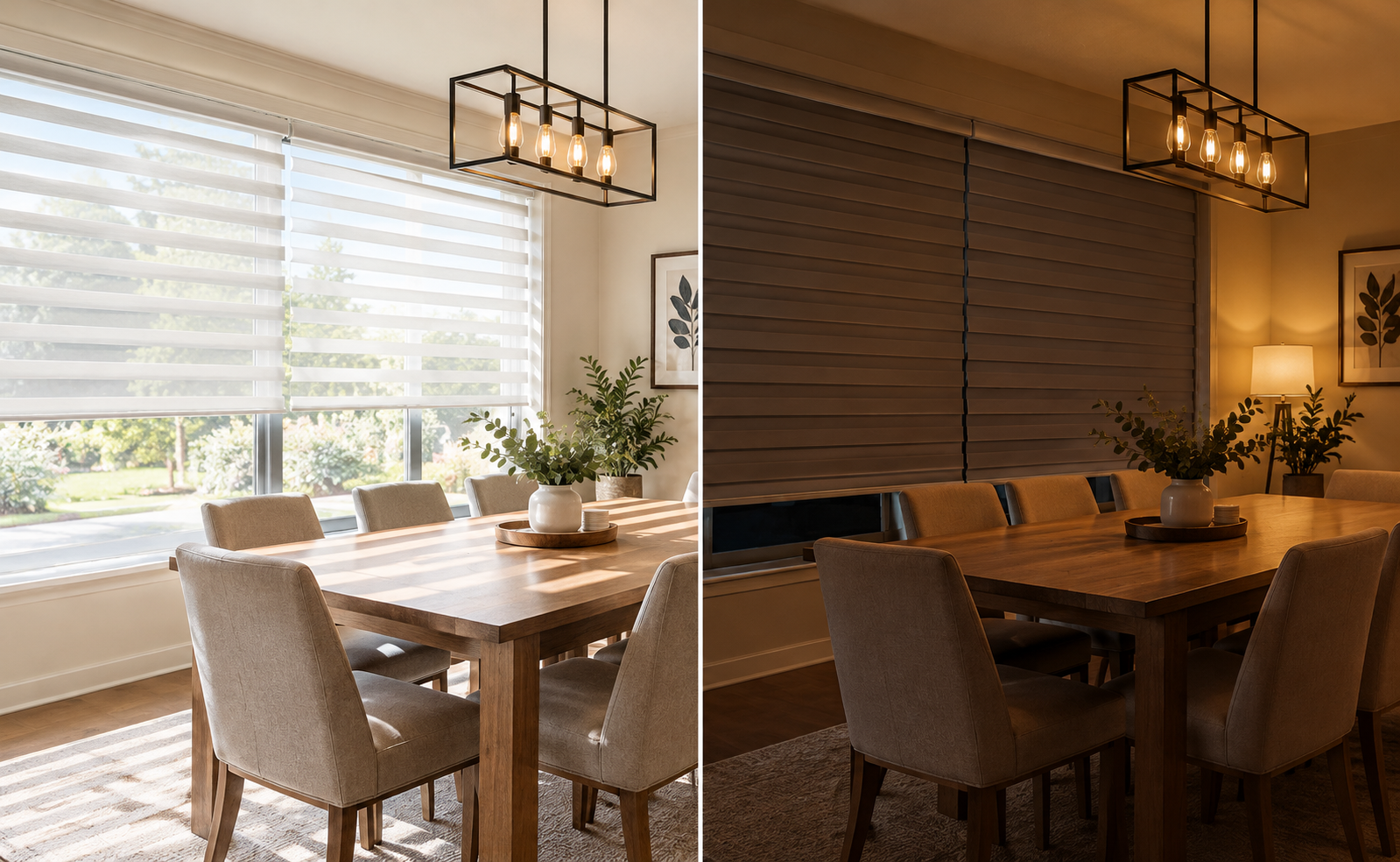
A dining room can have two very different identities within the same day. In daylight, it may feel open, bright and connected to the garden or street outside. By evening, the priorities shift: privacy becomes more noticeable, artificial lighting changes the colours in the room and the window itself can become a dark reflective surface.
That change makes the dining room an interesting place to choose blinds. The best solution should preserve the qualities that make the room enjoyable during the day while allowing it to feel more enclosed and comfortable once the lights are on.
Rather than asking which blind looks best in one fixed position, it is more useful to think about how the room moves from breakfast or daytime use into evening meals and entertaining.
Let the daytime view do some of the work
If the dining room has a pleasant outlook, there is little reason to hide it unnecessarily.
A garden, mature trees or an attractive street can become part of the room during the day. In those circumstances, the window treatment should provide control without permanently reducing the connection outside.
Start by considering how much of the glazing actually needs screening.
A window overlooked only at one angle may not require the same level of daytime privacy as one directly facing a pavement. Likewise, a first-floor dining room can have very different needs from a ground-floor space.
For households considering blinds baildon for a dining area with good natural light, preserving that openness can be just as important as deciding how the room will be screened later in the day.
The daytime aim is often not maximum coverage, but enough flexibility to control brightness and privacy without making the room feel closed.
Evening privacy changes the window completely
The dining room often feels most exposed after dark.
During the day, the exterior is usually brighter than the interior. At night, that relationship reverses. Once pendant lights, wall lights or lamps are switched on, the window may offer a clearer view into the room than it did earlier.
That is why a blind should be assessed under evening conditions rather than judged solely in daylight.
Think about the view from outside towards:
- the dining table;
- nearby seating;
- the route through the room;
- and any adjoining kitchen or living space visible through the same window.
Privacy does not always require the room to feel sealed off. The useful question is whether the blind gives enough control to make the space feel comfortable once the exterior has gone dark.
Use the blind to support the room’s change of mood
Dining rooms often become visually warmer in the evening.
Daylight gives way to pendant lighting, candles, lamps and reflected light from walls and furniture. The window treatment can contribute to that shift.
A blind that appears understated during the day may take on greater presence at night when the glass behind it becomes dark. Texture can become more noticeable, deeper colours can feel richer and warm neutrals can help soften the transition from bright daylight to evening light.
This makes it worth considering both versions of the room when choosing samples.
A pale material may keep the space fresh and open during the day but appear too stark under warm evening lighting. A deeper tone may feel stronger in sunshine but perfectly balanced once the table is set and the main lights are dimmed.
Neither is right or wrong. The best choice is the one that works convincingly in both conditions.
Watch how artificial light changes colour
Dining rooms are particularly sensitive to lighting because the atmosphere is often created deliberately.
A warm pendant over the table can change the appearance of walls, timber, upholstery and the blind. Colours that looked cool in daylight may become much warmer in the evening. Creams can take on yellow undertones, greys may appear softer and darker colours can become more saturated.
This is one reason samples should be viewed at the actual window rather than chosen from a screen.
Place the sample where the blind will sit, then look at it:
- in morning light;
- in afternoon light;
- with the main dining light switched on;
- and with any lamps normally used in the evening.
The blind should not need to look identical in every condition. In fact, a subtle change can add depth to the room. What matters is that the change still feels intentional.
Think about what happens during long meals
A dining-room blind may remain in one position for several hours.
That is different from a kitchen blind that is adjusted quickly while cooking or a bedroom blind that may be opened in the morning and closed at night.
Low evening sun can be particularly disruptive if it falls directly across the table or into somebody’s eyes. In summer, this may happen just as the room is being used for dinner.
A treatment that allows some adjustment can therefore be valuable.
Someone looking at blinds saltaire for a dining room that catches strong late-day light should consider the angle of that light at the table rather than simply whether the room is generally bright.
The position of the diners matters more than the brightness of the window in isolation.
Make the table the centre of the composition
In a dedicated dining room, the table is usually the visual anchor.
The blind should support it.
Look at the colour and material of the table, dining chairs and pendant light. A strong timber table can work beautifully with warm neutrals or softened natural tones at the window. Upholstered chairs may introduce a colour worth repeating subtly elsewhere.
The blind does not need to match any one piece exactly.
What matters is creating a relationship between the largest elements in the room.
If the table is sculptural or the chairs are strongly coloured, a quieter blind can provide balance. If the furniture is simple, the window may be a suitable place for more texture or pattern.
A dining room often feels most composed when there is a clear hierarchy: one or two elements lead, while the others support them.
Pattern should complement the room, not compete with the table setting
Patterns can work especially well in dining rooms because the room is often used in a more decorative way than a kitchen.
However, it is worth considering what else appears when the table is in use.
Table linen, crockery, flowers and seasonal decorations can introduce temporary patterns and colour. A very dominant blind may compete with these details, particularly in a smaller room.
A more restrained pattern can provide character without dictating every future styling decision.
If the room already contains patterned wallpaper or strongly upholstered chairs, a simpler blind may give the scheme enough breathing space.
Pattern is most successful when it remains part of the room after the table has been cleared, rather than only working with one particular arrangement.
Large windows need proportion, not just colour
The scale of the window can have a major effect on how the blind looks.
A treatment that feels subtle on a small sample may have considerable visual presence once it spans a wide dining-room window or set of doors.
Strong colours become stronger. Repeated patterns become more dominant. Texture becomes easier to see.
It helps to step back and imagine the whole area covered rather than judging a small piece of material at close range.
Photographing the window straight on can be useful for understanding proportion. Look at how much of the wall the glazing occupies and whether the window already dominates the room.
If it does, the blind may not need additional visual emphasis.
Keep smaller dining rooms visually open
A compact dining room can become heavy surprisingly quickly.
A large table, chairs, sideboard and pendant light already occupy significant visual space. A bulky or high-contrast window treatment can add another strong element.
That does not mean small dining rooms must use pale blinds.
A deep colour can work beautifully, particularly in rooms intended to feel intimate. The key is whether the rest of the scheme supports that decision.
Where the goal is to preserve a lighter feel, consider how much visible glass remains when the blind is open and whether the treatment creates unnecessary bulk around the window.
The open position is particularly important if the blind will spend most daylight hours raised.
Connect the blind to adjoining spaces
Many dining rooms are no longer completely separate.
They may open into a kitchen, form part of an open-plan living area or sit behind wide internal doors. The dining-room blind may therefore be visible from several other parts of the home.
It does not need to match neighbouring window treatments exactly, but some connection helps.
That connection might come from:
- a repeated undertone;
- similar texture;
- related hardware;
- comparable visual weight;
- or colours already shared by both spaces.
For homeowners considering chorlton-cum-hardy blinds for a dining area that connects directly with another room, looking back towards the window from the adjoining space can reveal whether the treatment feels integrated or unnecessarily separate.
A dining room can have its own character without appearing disconnected from the rest of the interior.
Do not overlook the view of the blind when it is closed
The closed position matters more in a dining room than people sometimes expect.
In summer, evening meals may still take place in daylight, but for much of the year the blind may be closed whenever the room is used after work.
That means the closed blind becomes a substantial part of the evening interior.
Look at the wall as a whole.
Does the blind create a large flat block of colour? Does the texture add enough interest? Does it sit comfortably behind the table and chairs? Does it make the room feel warmer, calmer or unexpectedly darker?
A blind chosen purely for its open daytime position may feel very different once it occupies the entire window after sunset.
Consider the balance between privacy and view
Dining rooms often benefit from a sense of connection to the outside, even after daylight begins to fade.
Some households may want complete visual separation once the lights are on. Others may prefer to retain some sense of the garden or exterior where privacy conditions allow.
There is no universal answer.
The decision depends on:
- neighbouring properties;
- street proximity;
- room orientation;
- garden layout;
- and how private the occupants want the dining experience to feel.
It can help to stand outside after dark and look back towards the room where practical. The view may be more revealing than assumptions made from inside.
Choose a blind that is easy to adjust without interrupting the room
Dining spaces are social spaces.
If a blind needs adjusting halfway through a meal because of low sun or privacy, it should be simple to operate without moving furniture or squeezing behind chairs.
Check the route to the window.
A sideboard, plant or dining chair may make a control awkward to reach. Large tables can also restrict access, particularly in narrower rooms.
These practical details are easy to overlook while decorating but become obvious during everyday use.
The most successful solution is one that can change the mood of the room without making the household rearrange it first.
Use texture to make evening lighting more interesting
Texture often becomes more noticeable after dark.
Directional lighting can create slight variations across woven or tactile surfaces, giving the window more depth than a completely flat finish.
This can work particularly well in dining rooms because evening lighting tends to be softer and more atmospheric than task lighting elsewhere in the home.
Texture should still be chosen with the rest of the interior in mind.
A heavily textured blind may compete with patterned wallpaper or ornate furniture. In a simpler room, it may provide exactly the layer that stops the space feeling too plain.
Again, the aim is balance rather than choosing the most decorative option available.
A practical day-to-night checklist
Before deciding on the final treatment, consider:
- How much daylight do you want to retain during the day?
- Is the room overlooked from the street or neighbouring properties?
- Does evening lighting make the interior more visible from outside?
- Does low sun ever reach diners directly?
- Which colours already dominate the table, chairs and flooring?
- How does the blind sample change under artificial lighting?
- What does the treatment look like fully closed?
- How much glass remains visible when it is open?
- Is the blind easy to adjust from around the dining furniture?
- Does it relate naturally to adjoining rooms?
- Is the pattern already coming from wallpaper, chairs or table styling?
- Does the window need to feel open by day and more enclosed by night?
The best answer is rarely the treatment that performs only one of those jobs exceptionally well. It is the one that handles the transition between them comfortably.
Let the dining room have two identities
A dining room does not have to look or feel the same at midday as it does over an evening meal.
During the day, the window can bring in light, views and a greater sense of space. After dark, the blind can help the room feel more private and visually complete.
Choosing successfully is therefore less about finding one perfect daytime appearance and more about creating a window treatment that works through the change. When colour, privacy, light and atmosphere have all been considered together, the dining room can feel bright when it should and comfortably enclosed when the day is over.
Frequently Asked Questions
Should dining-room blinds be light-coloured to keep the room bright?
Not necessarily. Pale colours can help maintain a lighter visual appearance, but darker treatments can also work well if the room receives good daylight and the wider palette supports them. Consider how the blind looks both open during the day and closed at night.
Why does dining-room privacy become more important after dark?
Once indoor lighting becomes brighter than the exterior, people and movement inside may be easier to see from outside. A room that feels relatively private during daylight can therefore feel more exposed in the evening.
Can patterned blinds work in a formal dining room?
Yes. Patterns can add character, but it should be considered alongside wallpaper, upholstery, artwork and table styling. If several other elements are already visually strong, a quieter window treatment may create better balance.
Should dining-room blinds match those in an adjoining kitchen?
They do not have to be identical. Related colours, textures or finishes can create continuity while allowing each room or zone to respond to its own practical needs.
When should I view blind samples for a dining room?
Ideally, view them in the actual room during daylight and again with the evening lighting switched on. Dining spaces can change considerably after dark, so both conditions are important when judging colour and texture.

 Welcome to CreativeGeneralist.com, your premier destination for authentic news, captivating stories, and insightful posts curated from across the globe. We meticulously select diverse content to inform, entertain, and inspire.