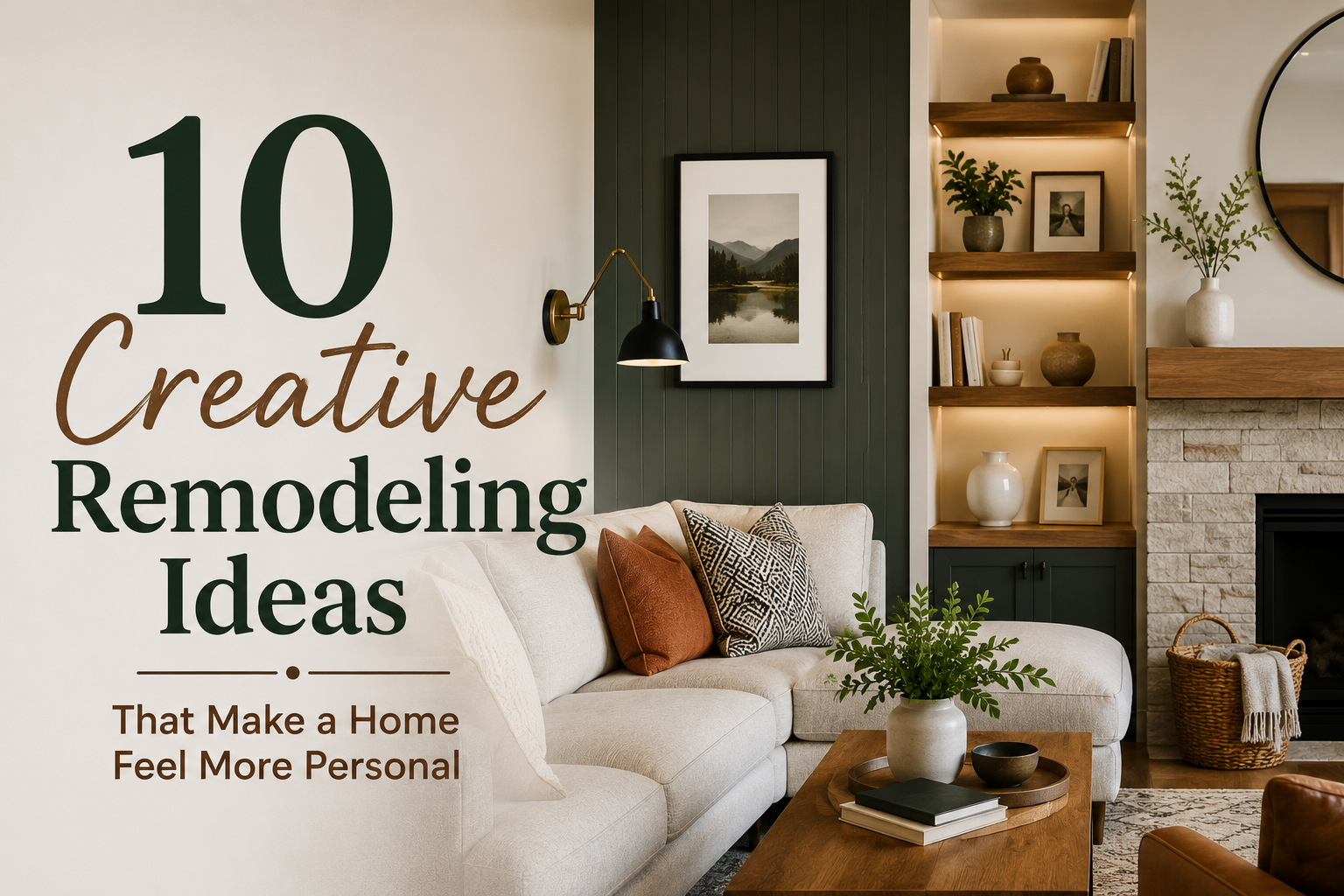
A remodel can make a home newer without necessarily making it more personal.
That is one of the biggest differences between updating finishes and truly redesigning a space.
New cabinets, flooring, tile, and paint can improve appearance, but the most memorable homes usually include details that reflect how the people inside actually live. They solve specific everyday problems. They use space in unexpected ways. They create visual interest without making the house feel overdesigned.
Personalization does not have to mean expensive custom architecture.
Often, the best ideas are small decisions that improve both function and character.
These creative home remodel ideas show how lighting, built-ins, indoor-outdoor connections, storage, and thoughtful design details can give a home more personality without sacrificing practicality.
Here are ten ideas worth considering during a remodel.
Why the Best Remodels Do Not Look Like Showrooms
A showroom is designed to display products.
A home is designed to support daily life.
That difference matters.
A perfectly coordinated kitchen may look impressive but still feel generic if it ignores how the household actually uses the space.
A successful remodel should respond to questions such as:
- Where does clutter accumulate?
- Where do people naturally gather?
- Which rooms feel underused?
- Where is storage missing?
- Which spaces need better light?
- What parts of the house already have character worth preserving?
The goal is not to make every room unusual.
It is to make the design feel intentional.
1. Turn an Awkward Corner Into a Built-In Feature
Almost every home has an area that is difficult to furnish.
It may be:
- a shallow wall,
- an unused corner,
- space under stairs,
- an awkward transition between rooms.
Instead of ignoring it, consider turning it into something useful.
Possible ideas include:
- built-in shelving,
- a reading nook,
- a small desk,
- display storage,
- a window seat,
- concealed cabinets.
Built-ins can make a home feel more architectural because they appear to belong to the room rather than simply being placed inside it.
They can also use space more efficiently than freestanding furniture.
2. Create a Kitchen Around the Way You Actually Live
Kitchens often become generic because they are designed around standard assumptions.
But households use kitchens differently.
One family may cook elaborate meals every day.
Another may care more about entertaining.
Someone may need a large pantry.
Another homeowner may prefer a dedicated coffee station over additional traditional cabinetry.
Instead of asking what a kitchen is supposed to include, ask how your household uses it.
That can influence:
- island size,
- seating,
- appliance placement,
- pantry design,
- prep space,
- storage.
A personalized kitchen is not necessarily more expensive.
It is simply organized around real habits.
3. Use Statement Lighting as Part of the Architecture
Lighting is often treated as a finishing touch.
It can be much more than that.
A strong fixture can help define a room visually.
Possible locations include:
- above a kitchen island,
- over a dining table,
- in a stairwell,
- above a freestanding bathtub,
- in an entry.
Statement lighting works best when it has enough space around it.
Too many decorative fixtures can compete with one another.
One or two intentional focal points often create a stronger result than trying to make every light fixture special.
The surrounding lighting should still provide practical illumination.
Decorative lighting and task lighting should work together.
4. Connect Indoor and Outdoor Living Spaces
One of the most effective ways to change how a home feels is to improve its relationship with the outdoors.
This might involve:
- larger doors,
- improved windows,
- a covered patio,
- better sightlines,
- consistent flooring tones,
- improved exterior lighting.
The goal does not have to be a dramatic glass wall.
Sometimes simply aligning a dining area with outdoor seating can make both spaces feel more connected.
Indoor-outdoor planning can also make smaller homes feel larger because views extend beyond the physical walls.
Climate should influence the design.
Covered areas, drainage, shading, and durable exterior materials may be just as important as the visual connection.
5. Add a Dedicated Coffee, Beverage, or Breakfast Station
Small specialized zones can make daily routines easier.
A beverage station might include:
- coffee equipment,
- mugs,
- glassware,
- a small sink,
- an under-counter refrigerator.
This can reduce congestion in the main kitchen.
It also creates an opportunity to use different cabinetry, tile, or lighting without redesigning the entire room.
Similar ideas include:
- baking stations,
- breakfast cabinets,
- hidden appliance garages.
The best version is based on something the household already does frequently.
6. Use Custom Storage Instead of Adding More Furniture
Storage problems are often solved by buying more furniture.
That can make rooms feel crowded.
A remodel creates an opportunity to integrate storage into the architecture.
Options include:
- full-height cabinetry,
- built-in benches,
- window-seat drawers,
- recessed shelving,
- mudroom storage,
- hidden pantry cabinets.
Custom storage works particularly well in narrow hallways, entries, and rooms with unusual dimensions.
It can also reduce visual clutter.
A wall of simple built-ins may feel calmer than several unrelated cabinets, baskets, and shelves.
7. Mix Old and New Materials Instead of Replacing Everything
A remodel does not have to erase every sign of the original house.
Existing materials can sometimes become part of the new design.
Examples might include:
- restoring hardwood flooring,
- keeping original brick,
- reusing wood doors,
- preserving trim,
- incorporating vintage hardware.
Pairing older elements with cleaner new finishes can create a home that feels layered rather than brand new.
This approach can be especially effective in older properties where original details are part of the home’s character.
The important thing is to distinguish between materials worth preserving and components that genuinely need replacement.
8. Create Flexible Rooms That Can Change Over Time
Households change.
A room that is an office today may become:
- a guest room,
- nursery,
- hobby space,
- study.
Designing for flexibility can make a remodel more useful long term.
This might involve:
- keeping closet space,
- providing enough electrical outlets,
- avoiding overly specialized built-ins,
- using adaptable lighting.
Flexible design does not mean making every room generic.
It means avoiding decisions that make future changes unnecessarily difficult.
9. Use Natural Light to Change How a Room Feels
Natural light can influence a room more than almost any finish.
A dark room may feel smaller and less inviting even after an expensive remodel.
Possible improvements include:
- enlarging windows,
- adding skylights,
- creating interior openings,
- using glass doors,
- reducing visual barriers.
But more glass is not always better.
The design should consider:
- privacy,
- glare,
- heat gain,
- furniture placement.
Sometimes repositioning one window creates more benefits than adding several smaller ones.
10. Carry a Few Design Ideas Through the Entire House
One of the easiest ways to make a remodeled home feel cohesive is to repeat a small number of design ideas.
This might include:
- similar cabinet profiles,
- consistent wood tones,
- repeated metal finishes,
- related lighting shapes,
- recurring tile colors.
The goal is not to make every room identical.
It is to create visual connections.
A home can contain different moods while still feeling like one project.
When several rooms are being redesigned together, a whole home remodel creates an opportunity to coordinate cabinetry, materials, lighting, built-ins, and architectural details instead of treating each room as a separate design exercise.
Why Personality Should Come After Function
Creative remodeling works best when function is already solved.
A dramatic kitchen island is not useful if it blocks circulation.
A sculptural bathtub is not successful if it makes the bathroom difficult to use.
A beautiful built-in is wasted if it does not store what the homeowner actually owns.
That is why the sequence matters:
- solve the layout,
- solve storage,
- solve lighting,
- then add personality.
Creative details become stronger when they improve the space rather than compete with it.
Avoid Designing Around Short-Lived Trends
Trends can be useful inspiration.
The problem begins when the entire remodel depends on one trend.
Highly specific:
- colors,
- tile patterns,
- fixtures,
- finishes
may feel dated sooner than expected.
A safer approach is to keep permanent elements relatively timeless and use easier-to-change features for experimentation.
Paint, hardware, lighting, art, and furnishings can introduce personality without locking the entire house into one moment.
Let One Room Be Different
Cohesion does not mean uniformity.
Sometimes one room benefits from having its own identity.
A powder room, office, or guest bedroom can be a good place to experiment.
This may include:
- darker paint,
- unusual wallpaper,
- distinctive tile,
- sculptural lighting.
Because the room is somewhat contained, it can feel special without disrupting the rest of the house.
Use Architecture Before Decoration
Some of the strongest design features are built into the structure.
Examples include:
- arches,
- ceiling details,
- built-in niches,
- window seats,
- custom millwork.
These details often have more lasting impact than decorative accessories.
They also make the home feel more intentional.
If architectural details are part of the plan, they should be developed early because they can affect framing, electrical work, drywall, and cabinetry.
Think About What Guests See First
The first few spaces people experience can influence how the entire home feels.
This may include:
- the entry,
- hallway,
- living room,
- kitchen.
A remodel can improve those transitions through:
- sightlines,
- lighting,
- flooring,
- storage,
- architectural openings.
The goal is not to impress visitors.
It is to make the home feel easier to understand from the moment someone enters.
Final Thoughts
The best creative remodeling ideas are not necessarily the most dramatic.
They are the ones that make the home feel more specific to the people living there.
A custom built-in in an awkward corner.
A kitchen designed around actual routines.
A better connection to the backyard.
Lighting that becomes part of the architecture.
Materials from the original home preserved instead of discarded.
These decisions create character because they come from the house and the household rather than from a generic trend.
A successful remodel should not only look newer.
It should feel more intentional, more useful, and more personal than it did before.

 Welcome to CreativeGeneralist.com, your premier destination for authentic news, captivating stories, and insightful posts curated from across the globe. We meticulously select diverse content to inform, entertain, and inspire.